
Writing and photographs by Dean Andrews
The Australian Opals were ranked third in the world entering the FIBA Women’s Basketball World Cup 2026 in Berlin, Germany and are attempting to have their third consecutive podium finish at a major championship. The Opals won the bronze medal at both World Cup 2022 on home soil in Sydney and the 2024 Paris Olympic Games. World Cup 2026 in Berlin commenced on Friday 4 September with 16 nations competing comprised of four groups with four nations each. Australia won their first two Group C games, having a 70-54 victory against Puerto Rico (ranked 13th in the world) on Friday 4 September and an 87-71 win against Türkiye (16) on Sunday 6 September.
In their third and final Group C game of World Cup 2026 Australia play Belgium who are ranked fifth in the world, two places below the Opals. Tip off of this crucial encounter on Monday 7 September is 11.30 am in Berlin, which is in prime time 7.30 pm Australian Eastern Standard Time (AEAST). Australia and Belgium have both their first two Group C games which means that the winner of their group game encounter will finish first in the group and qualify directly to the quarter finals. The team that is defeated will finish second in Group C and will play a qualification to quarter final game against the nation that finishes third in Group D.
At the past four major women’s basketball championships from the 2018 World Cup in Tenerife, Spain to the 2024 Paris Olympics the biggest gap between the finishing places for Australia and Belgium has been two places twice, both in favour of Australia, World Cup 2018 and World Cup 2022. In head-to-head games at major championships from 2018 to 2024 Australia have a two games to one advantage over Belgium. At the most recent major championship in the traditional five on five format of basketball the two nations met in the women’s bronze medal game at the Paris 2024 Olympics with Australia defeating Belgium 85-81 to finish on the podium and win the bronze medal. Belgium have more continuity with their team from the 2024 Paris Olympics to the 2026 World Cup than Australia. More information on Australia and Belgium’s performances at major championships from 2018 onwards including in head-to-head games against each other is provided later in this article.
Only two members from the Opals bronze medal winning team at World Cup 2022 in Sydney are playing for Australia four years later at WC 2026 in Berlin – Steph Talbot and Ezi Magbegor. This highlights how quickly rosters in women’s international basketball can change. Sandy Brondello is Australia’s Head Coach for a third consecutive World Cup, with the Opals having finished on the podium at the previous two WC’s, winning the silver medal in 2018 and the bronze medal in 2022. A duo that missed out on selection for WC 2022 in Sydney, Alanna Smith and Jade Melbourne were both starters on the Opals team that won the bronze medal at the Paris 2024 Olympic Games. Five members of the Opals bronze medal winning team at the Paris 2024 Olympic Games are in Australia’s team at World Cup 2026 in Berlin – Isobel Borlase, Magbegor, Melbourne, Smith and Talbot. The last four players listed all averaged more than 17.0 minutes per game in Paris to rank in the Opals top seven in this category along with then Opals captain Tess Madgen, Cayla George and Sami Whitcomb. Madgen retired after the 2024 Olympic Games having played a pivotal role with her leadership and on court performances in Australia winning the bronze medal at both World Cup 2022 in Sydney and the 2024 Paris Olympic Games.
For FIBA Women’s Asia Cup 2025 held in Shenzhen, China from 13 to 20 July five members of The Seven Consulting Australian Opals bronze medal winning team at the Paris 2024 Olympic Games were unavailable due to commitments in the United State of America with their Women’s National Basketball Association (WNBA) club. The players in this category were Magbegor, Melbourne, Smith, Talbot and Whitcomb. This enabled other players to be given greater responsibility representing Australia at a FIBA tournament. A new look Australian outfit played brilliant team basketball and at their fifth attempt in 2025 broke through to win the gold medal at FIBA Women’s Asia Cup for the first time. Two players that are making their major championship debut for the Opals at World Cup 2026 in Berlin, guard Steph Reid and forward Alex Fowler excelled at FIBA Women’s Asia Cup 2025 to earn selection in the tournament All-Star Five. Eight members of the Opals Asia Cup 2025 team are representing Australia at World Cup 2026 in Berlin with Fowler and Reid being joined in this category by Zitina Aokuso, Chloe Bibby, Isobel Borlase, Isabelle Bourne, Miela Sowah (nee Goodchild) and Ally Wilson.
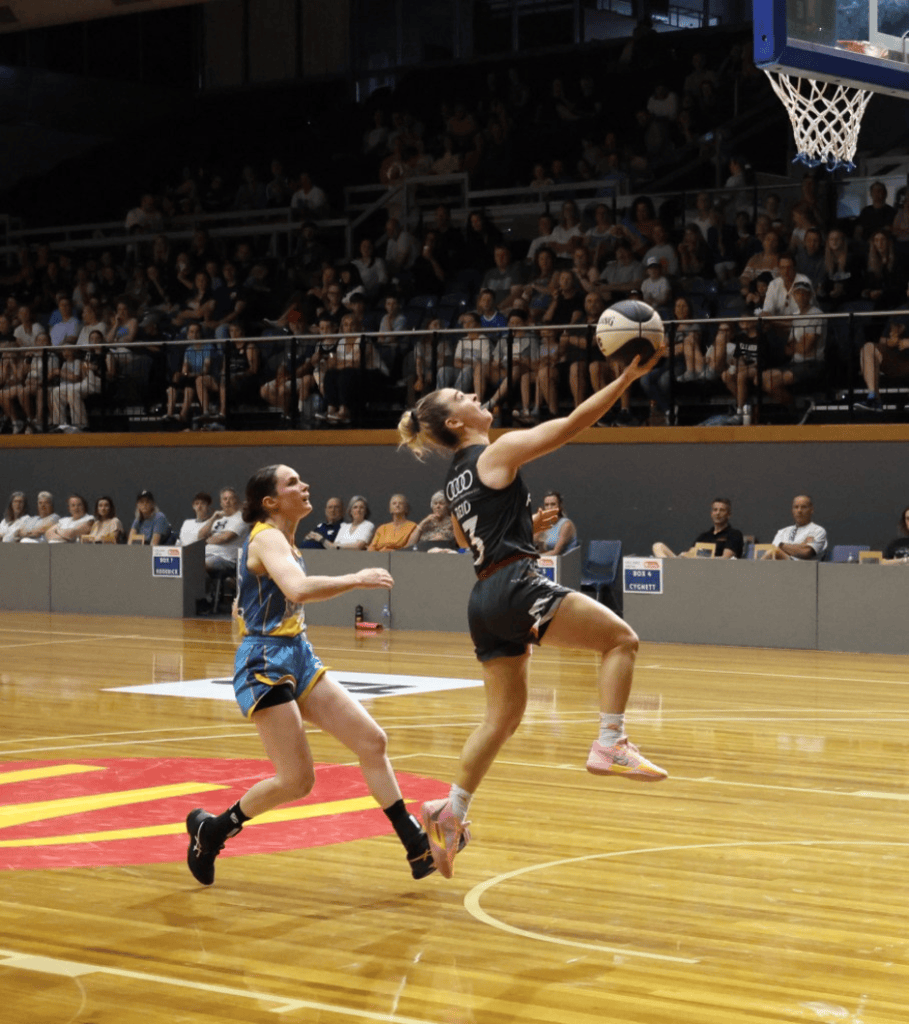
Steph Reid making a layup for Townsville Fire against Bendigo Spirit at Geelong Arena on 7 January 2024
Host nation Germany and continental cup winners, Australia (Asia), Belgium (Europe), Nigeria (Africa) and USA (America’s) were the first five nations that qualified for FIBA Women’s Basketball World Cup 2026 in Berlin. The remaining 11 spots to complete the field of 16 nations for WC 2026 were determined at four World Cup Qualifying tournaments that were held around the world from 11 to 17 March local time in each host city. The 24 nations competing at a WCQT 2026 included the five nations that had already qualified for WC 2026.
The dozen members of the Opals team for WCQT 2026 had all represented their nation at the 2024 Paris Olympic Games and / or Asia Cup 2025. Borlase and George were the only two players that represented the Opals at both the 2024 Paris Olympic Games and Asia Cup 2025. Paris 2024 Olympians Whitcomb, Talbot, Magbegor, Melbourne and Smith were all members of the Opals team for FIBA WCQT 2026. The Opals team in Istanbul was completed by five players that were members of the Opals gold medal winning team at Asia Cup 2025 – Aoksuo, Bibby, Fowler, Reid and Wilson. Australia won all five games in Istanbul with four of the victories being by less than 13 points. Australia’s narrowest win was by three points against host nation Türkiye 77-74.
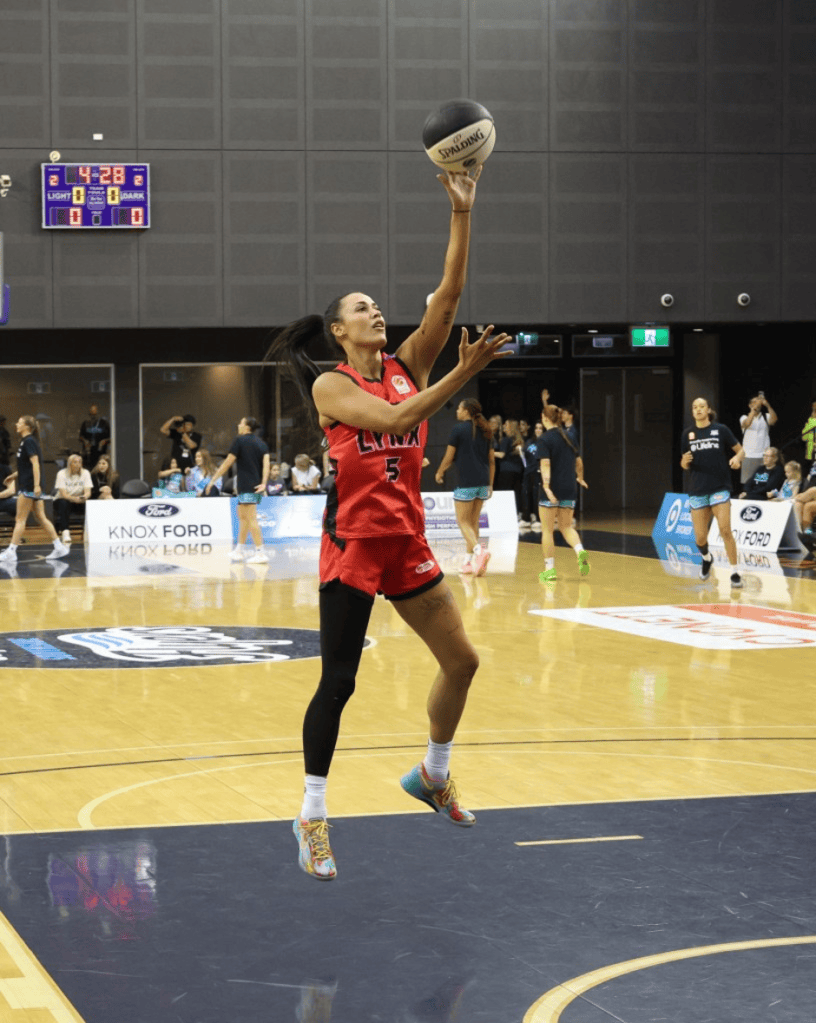
Ally Wilson during the warm-up for a Perth Lynx road game against Southside Flyers at the State Basketball Centre on 22 December 2024
10 of the 12 players that represented the Australian Opals at FIBA Women’s Basketball World Cup 2026 Qualifying Tournament in Istanbul, Türkiye are competing at World Cup 2026. The Opals were forced to make two changes to the WCQT 2026 team, Cayla George announced on 30 June that she was pregnant. Whitcomb was selected in the Opals 12 player WC team but had to withdraw due to a knee injury. The two additions to the Opals World Cup 2026 team that didn’t compete at WCQT 2026 in Istanbul are guard Sowah and forward Bourne.
Australia had another injury setback in their opening Group C game at World Cup 2026 against Puerto Rico with starter Smith suffering a lower leg injury in the second quarter and remaining on the bench for the second half. Smith made a significant impact in her 12 minutes and 13 seconds on court to score 10 points at 80% from the field and take eight rebounds. After the Opals first two games of World Cup 2026 eight players are averaging at least 5.0 points per game with Talbot ranking first in this category with 18.0 points per game followed by Magbegor with 16.0 points per game.
The article below includes the following information on the FIBA Women’s Basketball World Cup:
- General information on the 2026 World Cup tournament
- The Opals result for their first and second Group C games and schedule for their 3rd Group C game.
- The Australian Opals performances at their past four FIBA tournaments from World Cup 2022 to Asia Cup 2025
- Australian Opals history at the FIBA Women’s Basketball World Cup.
Australian Opals team for the FIBA Women’s World Cup 2026 in Berlin
Number Player 2026/27 team
22 Zitina Aokuso Adelaide Lightning (WNBL)
55 Chloe Bibby
20 Isobel Borlase Bendigo Spirit (WNBL)
34 Isabelle Bourne Sydney Flames (WNBL)
23 Alex Fowler Townsville Fire (WNBL)
13 Ezi Magbegor
2 Jade Melbourne Bendigo Spirit (WNBL)
12 Steph Reid Tasmania Jewels (WNBL)
11 Alanna Smith
1 Miela Sowah Townsville Fire (WNBL)
6 Steph Talbot Adelaide Lightning (WNBL)
4 Ally Wilson Sydney Flames (WNBL)
Coaches
Sandy Brondello Head Coach
Paul Goriss Associate Head Coach
Ranae Garlepp Assistant Coach
Kennedy Kereama Assistant Coach
The Opals 12 player team for World Cup 2026 in Berlin, Germany was announced on 27 July. The team included six members of the Opals bronze medal winning team from the Paris 2024 Olympic Games, Isobel Borlase, Ezi Magbegor, Jade Melbourne, Alanna Smith, Steph Talbot and Sami Whictomb. Six members of the Opals WC 2026 team would be making their major championship debut in Berlin, Zitina Aokuso, Chloe Bibby, Isabelle Bourne, Alex Fowler, Steph Reid and Ally Wilson. These six players were all members of the Opals gold medal winning team at Asia Cup 2025 In Shenzhen, China.
After naming the Opals 12 player team for World Cup 2026 Head Coach Sandy Brondello commented “I’m very confident in this group. We have a great mix of experience, talent and chemistry, Sami is the Opals captain and is an amazing leader. She will well supported by Ezi, Alanna, Steph and Jade. While our preparation is short with this full group, we trust the work we’ve done over the past few years, we believe in each other, and now it’s about being at our best when it matters most. If we play to our identity, we know we can compete with anyone.”1
On the composition of the Opals WC 2026 team Brondello told Basketball Australia “Our staff have done an outstanding job tracking players around the world since Paris. Australia is fortunate to have incredible depth, so selecting the Final 12 is never easy. We weren’t just looking at talent – we were looking for players who fit our style of play, embrace what it means to represent Australia, and put the team first. With only three days together before the World Cup, continuity was an important factor. We felt that players who already understood our system, had built chemistry within the program, and could hit the ground running. We believe this group gives us the best opportunity to be successful in Berlin.”2
One month after Australia’s World Cup 2026 team was announced on 27 July Opals captain Whitcomb was ruled out due to a knee injury. On 27 August Jason Smith, EGM of High Performance commented “While Sami is understandably disappointed not to be able to represent the Opals at the World Cup, her long-term health has to come first. Our thoughts are with Sami. We know how much representing the Opals means to her, and we recognise the enormous emotional and physical toll this situation has taken. Sami gives so much to this team, and while we are deeply disappointed that she will not be with us at the World Cup, our priority is her wellbeing, health, and long-term future. We will continue to support her in every way we can.”3
Miela Sowah was the late addition to the Opals World Cup 2026 team, replacing the injured Whitcomb. Sowah is one of nine players on the Opals 2026 WC team that have signed to play in the WNBL for the 2026/27 season. In 25/26 Sowah and fellow Opals WC team member Alex Fowler were teammates on Townsville’s WNBL Championship winning team, the duo will again be teammates at the Fire in 26/27. Sowah is one of seven players making their major championship debut in the traditional five on five format of basketball. Sowah is one of two Opals 26 WC team members along with Ally Wilson that have represented the Australian Gangurrus in a FIBA 3×3 World Cup. Sowah and Wilson were teammates on the Gangurrus team that finished fifth at FIBA 3×3 World Cup 2025.
With Whitcomb missing World Cup 2026 due to a knee injury Australia needed to name a new captain for the tournament. In Berlin Opals Head Coach Brondello announced to the team that Ezi Magbegor had been appointed the Opals 15th captain. Brondello commented Ezi and I have been on a very long journey together. She made her first Opals team as an 18-year-old in 2018. It’s been an amazing career, just to watch her evolve as a player but also the leader she is. I know she is going to lead this team the right way, just like our former captains have in Sami and Madge.”4
Magbegor commented “I think the cool thing for me has been seeing all the different leadership styles in Sami (Whitcomb) and in Tess (Madgen) and everyone in this room. I’m grateful for the fact that I didn’t have to change who I was in order to be seen as a leader. I’m just very grateful that you guys believe in me and trust in me and I’m not going to change, I’m just going to be who I am. I’m here for everyone.”5
Guard Isobel Borlase at 19 years of age was the youngest member of the Opals bronze medal winning team at the 2024 Paris Olympic Games and averaging 6.8 minutes per game at the tournament. Borlase took her game to another stratosphere playing for Bendigo Spirit during the 2025/26 WNBL season to win the WNBL’s Suzy Batkovic Medal for league MVP and led the league with 22.8 points per game, the highest scoring average in the WNBL since the 2020 hub season in North Queensland.
Three quarters of the members of the Opals 12 player team at World Cup 2026 in Berlin will be playing in the WNBL in the 2026/27 season. Three of the four members of the Opals WC 2026 coaching panel will be a head coach of a WNBL team in 2026/27. Paul Goriss is the Associate Head Coach of the Opals and is the Head Coach of the UC Capitals. Opals Assistant Coach Kennedy Kereama is the Head Coach of Bendigo Spirit which has an Opals guard duo on their 26/27 roster, Borlase and Melbourne. Opals Assistant Coach Ranae Garlepp will coach Opals duo Ally Wilson and Bourne in her role as Sydney Flames Head Coach. Opals duo Talbot and Aokuso will be teammates at Adelaide Lightning during the upcoming 2026/27 WNBL season. After being members of Townsville Fires 2025/26 WNBL championship winning team Fowler and Sowah will again be teammates at the Fire in 2026/27. After two Australian summers playing in Europe, point guard Steph Reid returns to the WNBL and has signed with the Tasmania Jewels for their inaugural 2026/27 season in the WNBL.
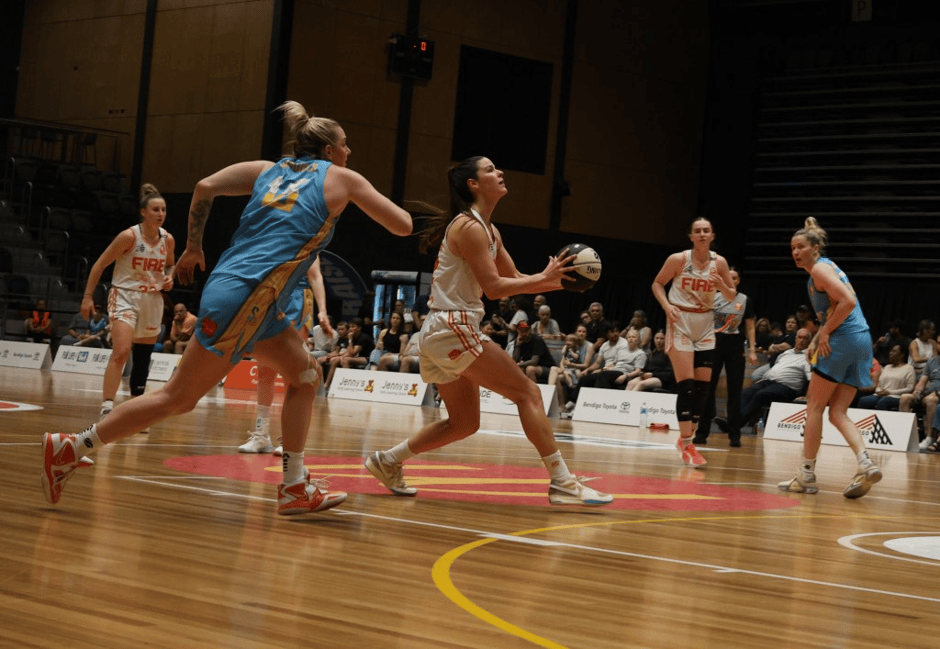
Alex Fowler playing for Townsville Fire against Bendigo Spirit at Red Energy Arena on 14 December 2024
Venue, Groups and nations competing at the 2026 FIBA Women’s Basketball World Cup 2026 in Berlin, Germany
The structure of the FIBA Women’s World Cup has changed from the previous edition of the tournament when 12 nations competed in Sydney in 2022 to the current 2026 edition that has sixteen nations competing in Berlin, the capital of Germany. In Sydney there were two groups of six nations each competing and the top four nations in each group progressed to the quarter finals. The group stage in Berlin will be comprised of four groups with four nations each. The nations that finish first in each group qualify directly to the quarter finals and the nations that finish fourth in each group will be eliminated from the tournament. The nations that finish second in each group play a qualification to quarter final game against a nation that finished third in another group to determine four of the quarter final berths at FIBA Women’s World Cup 2026. Group A and B crossover against each other with second in group A playing third in group B and second in group B playing third in group A. Group C and D crossover against each other with second in group C playing third in group D and second in group D playing third in group C. The winners of these four qualification to quarter finals games play a quarter final against a nation that finished first in a group.
Two venues will host games at World Cup 2026, Berlin Arena which has a capacity of 14,000 people for basketball games and The Max-Schmeling-Halle which has a capacity of 9,000 people for basketball games.
Group A
Nation World Ranking Points
Spain 6 574.2
Japan 10 505.1
Germany 11 504.8
Mali 18 302.4
Group B
Nation World Ranking Points
France 2 596.6
Nigeria 8 525.2
Korea 15 405.5
Hungary 19 293.5
Group C
Nation World Ranking Points
Australia 3 596.4
Belgium 5 585.5
Puerto Rico 13 445.5
Türkiye 16 338.8
Group D
Nation World Ranking Points
USA 1 719.1
China 4 585.8
Italy 14 412.6
Czechia 17 337.3
USA are clearly the number one ranked women’s basketball team in the world with 719.1 points, 20.5% more than France in second place with 596.6 points. The gap from the second ranked nation in the world, France with 596.6 points to the sixth ranked nation on the world rankings, Spain with 574.2 points, is just 3.9%, an extremely small margin between five nations in the top six on the world rankings. The other nations in this bracket are Australia (596.4 points) in third place, China in fourth (585.8) and Belgium in fifth position (585.5). Three nations in the top 16 on the FIBA Women’s World rankings didn’t qualify for WC 2026, Canada (7th), Brazil (9) and Sebia (12).
Australian Opals (3) Group C results / schedule
Friday, September 4, Australia (3) 70 defeated Puerto Rico (13) 54
Sunday, September 6 Australia (3) 87 defeated Türkiye (16) 71
Monday, September 7 Australia (3) vs Belgium (5) at 11.30 am Berlin time / 7.30pm AEST*
*Australian Eastern Standard Time (AEST)
Five players on the Opals World Cup 2026 team had senior major championship experience in the traditional five on five format of basketball and seven players were making their major championship debut. Sandy Brondello was the Opals Head Coach for the third consecutive World Cup with Australia having finished on the podium at both previous WC’s, winning the silver medal at World Cup 2018, and winning the bronze medal at WC 2022 in Sydney. For the Opals opening game of World Cup 2026 against Puerto Rico the quintet with previous major championship experience started, Melbourne and Borlase in the back court along with Talbot, Smith and Magebegor in the front court. The seven Australian players commencing on the bench and making their major championship debut were guard trio Steph Reid, Miela Sowah and Ally Wilson along with front court quarter Zitina Aokuso, Chloe Bibby, Isabelle Bourne and Alex Fowler.
The Opals made the ideal start against Puerto Rico on Friday September 4 to open the game with a 7-0 run comprised of two made free throws for Melbourne, a three-pointer for Smith and a pullup jump shot for Borlase in the first minute and 45 seconds of the game. The Opals extended the lead to 13 points, 19-6 with one minute and 28 seconds left in the opening quarter. Puerto Rico responded with a 10-0 run of their own and when Trinity San Antonio made a turn around jump shot with eight minutes and 45 seconds left in the second term the deficit had been reduced to three points, 16-19. Puerto Rico outscored Australia 13-12 in the second quarter to reduce Australia’s lead to seven points at half-time 31-24. Smith started in phenomenal fashion to have 10 points at 80% from the field and eight rebounds but was substituted out of the game in the second term with a lower leg injury, having played 12 minutes and 13 seconds court time.
Midway through the third quarter Puerto Rico reduced the deficit to a solitary point, 36-37. After a time out from Brondello Wilson made a three-pointer from a Talbot assist with four minutes and 57 seconds left in the third quarter to extend the Opals lead to four points, 40-36. Guirantes responded to make a lay-up on the next possession to trim the margin to two points. It was to be Puerto Rico’s final score of the term and in the last three minutes and 35 seconds of the third quarter Australia went on an 11-0 run to increase the margin to 13 points 51-38. Australia outscored Puerto Rico 19-16 in the fourth quarter to record a 16 point victory, 70-54. Steph Talbot scored a game-high 19 points at 77.8% from the field, took eight rebounds and made three assists to be named the TCL Player of the Game. Talbot showed poise from long range to make four of six three-pointers at an accuracy of 66.7%. Four of the five Opals starters reached double figures in scoring with Talbot and Smith being joined in this category by Magbegor (11) and Melbourne (10). Magbegor and Aokuso took an equal team-high nine rebounds. The Opals convincingly won the assist count 16-6 with Wilson making a game-high four assists and Talbot and Borlase making three assists each. Talbot played a team-high 33 minutes and 16 seconds and was the only Opal to play more than 26 minutes court time.
Due to a lower leg injury Smith did not play in the Opals second Group C game against Türkiye and was replaced in the starting five by Isabelle Bourne. The Opals won all four quarters of the game and recorded an 87-71 victory against Türkiye. Opals captain Magbegor led her team with 21 points at 71.4 % from the field. After being hampered from a planter fascia injury in her right foot at the Paris 2024 Olympics Talbot has taken on an increased offensive role at World Cup 2026. Talbot scored 17 points against Türkiye, took an equal team-high five rebounds and made a team-high five assists.
In their third Group C game of World Cup 2026 in Belin world number three Australia play world number five Belgium with the winner to earn direct qualification to the quarter finals. The team that is defeated will finish second in Group C and will need to win a knockout game against the nation that finishes third in Group D to advance to the quarter finals. At the previous three major championships from 2018 to 2024 Australia and Belgium have finished close to each other in the final standings with the biggest gap between the two nations in this time being two places.
At World Cup 2018 in Tenerife Spain, Belgium and Australia did not have a head-to-head game against each other but both nations advanced to the medal games. Australia won a thrilling semi final against host nation Spain 72-66. Belgium made the semi finals and lost their last two games of the tournament to finish fourth. Belgium lost a semi final to the Unites States of America 77-93 and had one more chance to secure a medal, playing Spain in the bronze medal game. Belgium power forward Emma Meesseman scored 24 points and Belgium had the superior shooting accuracy, 46.2% to 38.5% but lost 60-67. Belgium committing more turnovers, 23 to Sapin’s 15 proved critical.
Belgium played Australia in their opening group of the 2020 Tokyo Olympics. Led by phenomenal all-round game from Meesseman with 32 points, nine rebounds and five assists Belgium recorded an 85-70 victory. Whilst Meesseman fell one rebound short of a double-double a Belgium teammate, guard Julie Allemand recorded a double-double comprised of 16 points and 11 assists. Belgium and Australia both lost in the quarter finals at the 2020 Tokyo Olympics with Belgium finishing seventh, one place ahead of Australia.
At World Cup 2022 in Sydney Messeman suffered a calf injury in her nation’s fourth group game which ended her tournament. In a quarter final Australia defeated Belgium 86-69. Australia went on to win the bronze medal, defeating Canada 95-65 in the playoff for third whilst Belgium finished fifth.
For the third major championship in a row Australia played Belgium at the 2024 Paris Olympic Games, this time a medal was one the line with the encounter being in the bronze medal game. The margin at the end of the first three quarters was a solitary point with Australia leading by a point at quarter time and half time and Belgium leading by a point at three quarter time. The Opals outscored Belgium 25-20 in the last quarter to have a four point victory 85-81. Magbegor was phenomenal for the Opals with 30 points at 70.6 % from the field and took a team-high 13 rebounds. Magbegor was one of two Opals to record a double-double, joined by Smith with 13 points and 12 rebounds. Belgium point guard Julie Vanloo recorded a double-double of her own comprised of 26 points and 11 assists. Messeeman scored 23 points and fellow forward Delaere scored 15 pts playing the full 40 minutes.
Belgium have had greater continuity with their team from the 2024 Paris Olympic Games to World Cup 2026. The Belgium starting five for their opening game of World Game 2026 against Türkiye was Julie Allemand, Julie Vanloo, Antonia Delaere, Emma Meesseman and Kyara Linskens. Four of these five players were in Belgium’s starting line-up at the Paris 2024 Olympics. Allemand is the exception, having missed the 2024 Paris Olympic Games due to a right ankle injury.
Players competing at FIBA World Cup 2026 that have experience playing in the WNBL and / or will make their WNBL debut in 2026/27:
16 players with @WNBL experience before the 2026/27 WNBL season will be playing for their nation at FIBA Women’s World Cup 2026. Another trio of players without previous WNBL experience will make their WNBL debut as imports during the 2026/27 season after representing their nation at World Cup 2026 in Berlin. The trio of 2026/27 WNBL imports in this category are China guard duo Siyu Wang (Southside Flyers) and Shuyu Yang (Sydney Flames) along with German centre Marie Gülich (Townsville Fire).
13 players representing their nation at FIBA Women’s World Cup 2026 are on a WNBL roster for the 2026/27 season comprised of nine Australian Opals, three Chinese players and one player from Germany.
Australian Opals (9 players): Zitina Aokuso (Adelaide Lightning), Isobel Borlase (Bendigo Spirit), Isabelle Bourne (Sydney Flames), Alex Fowler (Townsville Fire), Jade Melbourne (Bendigo Spirit), Steph Reid (Tasmania Jewels), Miela Sowah (Townsville Fire), Steph Talbot (Adelaide Lightning), Ally Wilson (Sydney Flames)
China (3 players): Han Xu (Geelong Venom), Siyu Wang* (Southside Flyers), Shuyu Yang* (Sydney Flames).
Germany (1 player): Marie Gülich* (Townsville Fire
*Will make their WNBL debut in the 2026/27 season.
Six players on a FIBA Women’s World Cup 2026 roster that haven’t signed with a WNBL club for 2026/27 but have previous experience playing in the WNBL:
Australian Opals (3 players): Chloe Bibby, Ezi Magbegor, Alanna Smith
Belgium (1 player): Julie Vanloo
Puerto Rico (1 player): Imani McGee-Stafford
USA (1 player): Jackie Young
Chinese centre Han Xu won the WNBL’s Robyn Maher Defensive Player of the Year Award playing for Perth Lynx in 2025/26. Xu led the league with 2.2 blocked shots per game, 16.2 points (ranked 7th in the WNBL) and 7.3 rebounds per game and was selected in the All-WNBL Second Team after playing her first game for Perth a third of the way through the regular season. Perth have had success recruiting high-profile imports, four seasons earlier American guard Jackie Young playing for the Lynx ranked third in the league with 17.6 points per game in 2021/22 and was selected in the All-WNBL First Team. Han Xu is playing a second consecutive WNBL season in 2026/27, having signed with Geelong Venom.
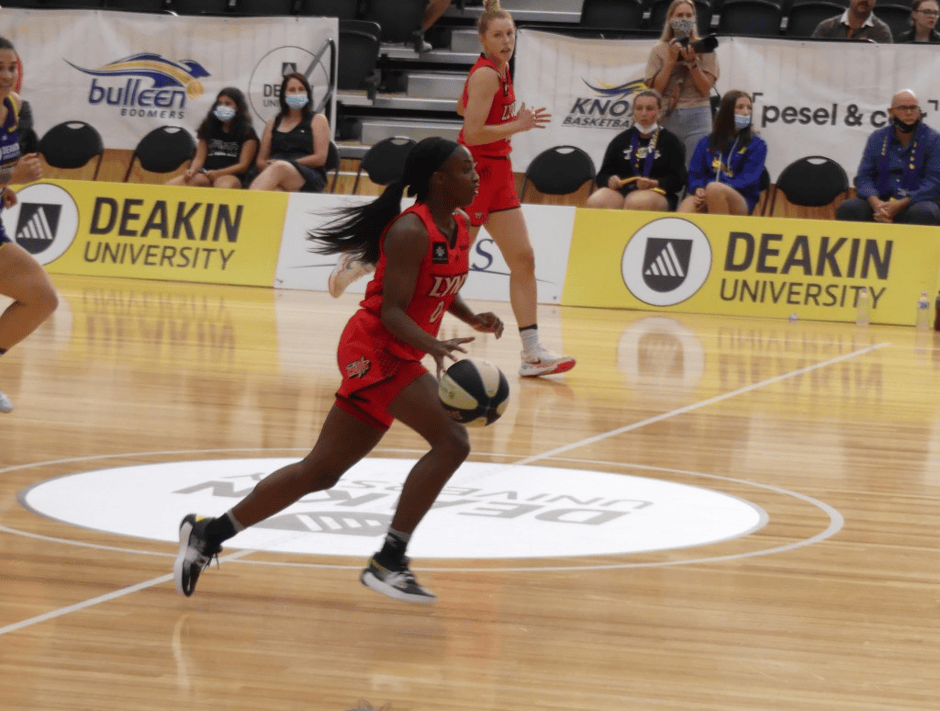
Jackie Young playing for the Perth Lynx against the Melbourne Boomers at Gippsland Regional Indoor Sports Stadium (GRISS), Traralgon on 6 February 2022
Summary of Australia’s history at the FIBA Women’s Basketball World Cup up to and including 2018
The 2026 FIBA Basketball Women’s World Cup is the 20th edition of the tournament and the second time that Germany has hosted the World Cup, having also hosted in 1998. Both times that Germany have hosted the World Cup the previous editions of the tournament in 1994 and 2022 were hosted by Australia in Sydney. The FIBA World Championship for Women was first held with eight nations competing in Chile in 1953, three years after the men’s first World Championship. The tournament was created by the International Basketball Federation (IBF). Not long after the 17th edition of the tournament in 2014 it was renamed the FIBA Women’s Basketball World Cup.
In the first 11 editions of the World Cup up to and including the 1990 edition Australia competed eight times, making their debut appearance in 1957, after missing the 1959 and 1964 World Cups Australia competed in every tournament from 1967 onwards. Up until the early 1990’s Australia only finished in the top eight twice – fourth at South Korea in 1979 and sixth at Malaysia in 1990. The first time that Australia finished in the top four at a FIBA Women’s World Championship Maree Jackson (nee Bennie) wearing the number 15 jersey led Australia with 17.7 points per game, ranked equal seventh overall at the 1979 tournament held in South Korea. At several later World Cups Maree’s daughter Lauren Jackson would replicate her mum’s feat of wearing the number 15 jersey and being Australia’s leading scorer at the tournament.
Australia hosted the tournament for the first time in 1994 with 16 nations competing at the 12th FIBA World Championship for Women held from 2 to 12 June. The tournament was also known as OZ 94. After pool games were played in Adelaide, Launceston and Hobart the finals were played in Sydney at the Sydney Entertainment Centre. Australia won four of their first six games at the 1994 World Championships to progress to the semi finals, their two losses were against fellow semi finalists, China (67-87) and the United States of America (70-88). Australia’s semi final opponent was China who had a 20 point victory when the nations met earlier at the tournament in a preliminary game. The semi final was extremely close with China prevailing by a solitary point, 66-65 to advance to the gold medal game. Australia lost a shoot-out to the United States of America 95-100 in the bronze medal game. In the gold medal game Brazil defeated China 96-87 to win the World Championships for the first time. Current Opals Head Coach Sandy Brondello was one of eight players that averaged more than 16.0 minutes and 6.5 points per game for Australia at the 1994 World Championships. The other players in this category were Robyn Maher, Michele Timms, Rachael Sporn, Shelley Gorman (nee Sandie), Allison Tranquilli (nee Cook), Trish Fallon and Michelle Brogan.
The Australian Opals broke through to win their first medal at the 13th FIBA World Championship for Women four years later at the 1998 tournament held in Germany with Tom Maher as the Head Coach. Several players that were members of Australia’s fourth placed team in 1994 that fell agonisingly short of winning a medal were members of the 1998 bronze medal team including Timms, Sporn, Brondello, Maher and Brogan. The 1998 WC team also included Maree Jackson’s daughter Lauren who made her major championship debut at 17 years of age as a forward wearing the Opals number 11 jersey. Australia lost to Russia 76-82 in a 1998 semi final and played the bronze medal game against reigning world champions Brazil. At half time Australia trailed Brazil by 12 points, 33-45. The Opals outscored Brazil 39-22 in the second half to win by five points 72-67, to finish on the podium at a FIBA Basketball Women’s World Championship for the first time, winning the bronze medal. Six players averaged more than 7.0 points per game in 1998 – Brogan (a team-high 13.1 points per game), Carla Boyd, Lauren Jackson, Sporn, Timms and current Opals Head Coach Sandy Brondello. Averaging 11.9 minutes per game Jackson ranked third for Australia with 10.9 points per game.
Jan Stirling took over as the Opals Head Coach in 2001 and held this role for the next two World Championships. In the group and classification stage at the 2002 World Championships Australia won five of their six games with the loss being by a point to Brazil 74-75. The Opals easily accounted for France, 78 to 52 in a quarter final. USA defeated Australia 71 to 56 in a semi-final at the 2002 World Championships. In the bronze medal game Australia led Korea 46-33 at half-time and extended the lead in the second half to defeat Korea 91-63 and won the bronze medal. Jackson averaged 23.1 points per game to be ranked first overall at the tournament ahead of Russian forward Elana Baranova (18.1 points per game). Making her major championship debut Penny Taylor averaged 13.1 points per game for the Opals and was the only other Australian that averaged more than 7.5 points per game.
Australia had a far from ideal preparation for the 2006 World Championships held in in Sao Paulo, Brazil, from September 12 to 23, only having one practice match against the USA five days before the start of the tournament. The 12 members of the Opals team were Lauren Jackson, Penny Taylor, Kristi Harrower, Jenny Whittle, Belinda Snell, Tully Bevilaqua, Laura Hodges (nee Summerton), Hollie Florance (nee Grima), Erin Phillips, Jennifer Screen, Emily McInerney and Emma McDonald (nee Randall).
At the 2006 World Championships Australia won by forfeit over Lithuania in their opening game due to Lithuania not reaching Brazil in time for their game, party due to a flight cancellation. Members of the Opals family and fans were at the stadium and with Australia needing more match practice the Opals played a game amongst themselves with the coaches picking two teams.
Australia won their next five matches to progress to the quarter finals, however two of the wins were by less than 10 points, defeating Spain and Brazil by four points and nine points respectively. The Opals won their quarter-final against France 79-66. Host nation Brazil led the semi-final against Australia by seven points at three quarter-time, however Australia controlled the final quarter 31-12 to win by 12 points, 88-76 and progress to the gold medal game. The Opals had the three highest scorers in the semi final victory – Taylor 26 points at 80% from the field, Snell 22 points at 66.7% from the field and Jackson 19 points. Point guard Harrower scored nine points, took 10 rebounds and had six assists to set game-highs in the latter two categories. In a semi-final on the same day (21 September) Russia upset the USA 75 points to 68 to end the USA’s 50 game winning streak at major championships.
In front of a crowd of 4,500 people Australia won every quarter of the 2006 gold medal game on 23 September against Russia to win in convincing fashion by 17 points, 91-74. Taylor scored a game-high 28 points – 11 more than the second ranked player and put on a sublime shooting display all over the court to make 9 of 14 field goal attempts (64.3%), including three of five three-points shots and took nine rebounds. Four Opals reached double figures with Taylor being joined in this category by Jackson 16 points and a team-high 11 rebounds, Harrower (15 points) and Snell (12).
Taylor was rewarded for her brilliant all-round 2006 World Championships, phenomenal shooting and outstanding form at the business end of the tournament by being named the Most Valuable Player of the tournament ahead of team-mate Jackson in second place. Jackson ranked first in scoring at tournament with 21.3 points per game and Taylor ranked third in this category with 18.0 points per game. Proficient shooting played a critical role in the Opals success at the 2006 World Championships with the team shooting at 56.1% from the field, ranked first at the tournament ahead of USA 50.9%.
At the 2010 World Championships from 23 September to 3 October in the Czech Republic with Carrie Graf as head coach Australia won their three matches in group A and two of their three matches in the eight-final round, losing to USA 75 to 83. Australia played hosts, the Czech Republic in a quarter-final and trailed 51 to 52 at three quarter-time. The Czech Republic controlled the final quarter to outscore Australia 27 to 17 to defeat the Opals by 11 points 79 to 68. Inaccurate field goal shooting proved costly for Australia, making only 20 of their 70 field goal attempts for an accuracy of 28.6%, significantly lower than the Czech Republic’s 37.5%. Australia defeated Russia 78 to 73 and France 74 to 62 to finish the World Championships in fifth position.
Under head-coach Brendan Joyce the Opals played an up-tempo style of basketball at the 2014 World Championships in Türkiye from 27 September to 5 October. The Opals had the same five starters for every game of the tournament – Taylor, Erin Phillips, Rachel Jarry, Laura Hodges and Marianna Tolo. Australia won each of their three Group C games by at least 33 points and had a 63-52 victory against Canada in a quarter final.
In a semi-final Australia trailed United States of America by 12 points at half-time and this ended up being the final margin with the Opals being defeated 70-82. Australia started the bronze-medal game against hosts, Türkiye in the best possible fashion, after the Opals scored the first 17 points of the game they were never threatened, recording a 74-44 victory to win the bronze medal.
Taylor averaged 12.0 points, 4.8 rebounds, 4.3 assists (ranked second overall) per game and was selected in the 2014 World Championships All-Star five. Current Opal Marianna Tolo led Australia in scoring with 12.2 points per game and ranked equal first with 5.2 rebounds per game.
Milestones and Misses published an article last week comprehensively covering Penny Taylor’s incredible basketball career including for the Opals, in the WNBA with the Phoenix Mercury and Cleveland Rockers and in the WNBL with the AIS and Dandenong Rangers. Below is a link to this feature article on Taylor:
At the 2018 FIBA Women’s World Cup held in Tenerife, Spain from 22 to 30 September Sandy Brondello was the head coach of the Opals. Australia’s starting line-up throughout the tournament was Katie Ebzery, Bec Allen, Steph Talbot, Cayla George and Liz Cambage. The Opals won each of their first four matches by at least 18 points to progress to a semi final against host nation Spain.
Australia started their semi final against host nation Spain in scintillating fashion to lead 21-6 with three minutes and 24 seconds remaining in the first quarter. Spain outscored Australia 52-29 in the next two and a bit quarters to lead 58-50 at three quarter time. The Opals fought back to level the scores at 64 points apiece with three minutes remaining in the game. George scored the next five points of the game comprised of two free-throws and a corner three to gain the ascendancy for the Opals, making two free throws with two minutes and 56 seconds left followed by a corner three-pointer with 2 minutes and 12 seconds remaining to extend Australia’s lead to five points, 69-64. Australia won the semi final 72-66 after dominating the final quarter 22-8.
It was the first time that Australia had progressed to a gold medal game at a major championship since they played the United States of America in the final at the 2008 Olympic Games, 10 years later USA were again the Opals opponents. In the gold medal game Australia trailed USA 27-35 at half-time. USA dominated the third quarter 26-11 and defeated Australia 73-56, resulting in the USA winning the gold medal and Australia receiving the silver medal. In the bronze medal game Spain defeated Belgium 67-60.
USA forward Brenna Stewart averaged 16.3 points per game ranked fourth at the World Cup and was named the Tournament MVP. Stewart was joined in the All-Star five by USA guard Diana Taurasi, Australian centre Cambage who ranked first overall with 23.8 points per game, leading rebounder Belgian forward Emma Messeeman (10.7 rebounds per game) and Spanish power forward Astou Ndour.
Highlighting how competitive women’s basketball is at international level 2018 World Cup bronze medallists Spain were unable to qualify for the 2022 World Cup despite being ranked second in the world. To progress to a 2022 World Cup Qualifying Tournament Spain needed to finish in the top six at EuroBasket 2021 held in Spain and France from 17-27 June, however they fell just short finishing seventh.
Detailed look back at the Opals bronze medal winning performance at FIBA Women’s World Cup 2022 in Sydney
Six members of Australia’s silver medal winning team from the 2018 World Cup held in Spain were members of the Seven Consulting Opals team for the FIBA Women’s World Cup 2022 in Sydney – Tess Madgen, Sami Whitcomb, Cayla George, Steph Talbot, Bec Allen and Ezi Magbegor. Three other members of Australia’s World Cup 2022 team had played for the Opals at a major championship – Marianna Tolo, Sara Blicavs and Lauren Jackson who was making her ninth appearance at a major championship, having been a member of the first three Opals teams to win World Cup medals in 1998, 2002 and 2006. The three members of the Opals team that made their major championship debut on home soil in Sydney were Kristy Wallace, Darcee Garbin and 2021/22 WNBL Most Valuable Player Anneli Maley.
Australia were hosting the FIBA Women’s World Cup for the second time in 2022, having previously hosted in 1994 when the tournament’s official name was 1994 FIBA World Championship for Women and was also known as OZ 94.
Eight of the top 10 ranked nations in the world were among the 12 nations competing at the 2022 FIBA Women’s World Cup with the 12 nations split into two groups of six teams. Group B was quickly labelled the ‘Group of death’ after five of the top 10 nations in the world, Australia (3), Canada (4), France (6), Japan (8) and Serbia (10) were all drawn into this group. With a world ranking of 37 Mali were the underdogs of Group B. In the first six days of the World Cup from Thursday 22 September to Tuesday 28 September each nation played five games comprised of one game against each of the other five nations in their group. All of the Seven Consulting Opals games were played at the Sydney SuperDome (also known as Qudos Bank Arena). Tess Madgen was appointed the Opals captain for World Cup 2022.
In Australia’s opening game of World Cup 2022 in Sydney against France on Thursday 22 September the Opals starters were Whitcomb, Allen, Talbot, George and Magbegor. After trailing France by five points at three-quarter time the Opals were outscored in the final term 10-18 and lost to France 57-70.
The Opals won their next two games, defeating Mali 118-58 and Serbia 69-54. The win against Serbia came at a cost with starter Allen suffering an injury to her ribs in the last quarter which forced her to miss the Opals final two Group B games. During the group phase Allen led the Opals with 13.3 points per game.
In the Opals fourth group game they played Canada who had won their first three games of the tournament. Canada looked to be in a commanding position leading 33-19 with four minutes remaining in the second quarter. For the remainder of the first half the Opals went on a phenomenal 19-0 run to lead 38-33 at half-time. The Opals went on to defeat Canada 75-72.
After losing their opening game to France, Australia had three consecutive wins to have the same win-loss record as Canada and France with one more day of group play remaining on Tuesday 27 September. If Australia, Canada and France all finished Group B tied on four wins and one loss, the points difference in the head-to-head games between these three nations would determine their positions, resulting in Canada finishing first, France second and Australia third.
In the first Group B game on Tuesday 27 September Canada defeated Mali 88-65 to secure a top two finish in the group. Australia got the result they wanted in the second Group B game at the Sydney SuperDome with Serbia defeating France 68-62. If Australia defeated Japan in their final Group B game they would finish on top of Group A but if they lost to Japan they would finish third, resulting in a quarter final game against one of the top two teams from Group A, the undefeated USA or China who’s only loss was to USA. Belgium finished third in Group A with three wins followed by Puerto Rico in fourth place with two wins. Korea with one win and Bosnia and Herzegovina with no wins were both knocked out of the competition at the end of the group phase.
With their speed and three-point shooting Japan had posed match-up problems for Australia in recent years, having defeated the Opals in three consecutive Asia Cups in 2017, 2019 and 2021. Japan won the silver medal at the Tokyo Olympics but had been unable to recapture that form at the 2022 World Cup and regardless of the result against the Opals would not advance to the quarter finals.
In the Opals final Group B game against Japan Australia had their fourth different starting line-up in their five group games with only Whitcomb and Talbot being starters for every game. Other starters against Japan were Blicavs, Magbegor and Tolo. The Seven Consulting Opals retained this starting line-up for the rest of the tournament. Australia led Japan by two points at half-time, 36-34. The Opals outscored Japan 20-9 in the third quarter to set-up a 71-54 victory.
Australia had four wins and one loss to finish on top of Group B ahead of Canada who had the same win-loss record. The Opals won the tie-breaker due to defeating Canada by three points in the head- to-head match between the two nations. Serbia and France were third and fourth respectively in Group B with three wins each, ahead of Japan with one win and Mali with no wins. The top four teams in each group advanced to the quarter finals.
After playing five games in six days all eight nations remaining in the tournament had a rest day on Wednesday 28 September before playing their quarter final on Thursday 29 September. Australia’s quarter final was against Belgium in the fourth and final game of the day.
Belgian power forward Emma Messeman suffered a calf injury in her nation’s fourth group game which ended her tournament. Messeman was selected in the All-Star five at the 2018 World Cup and scored 32 points in Belgium’s victory against Australia at the 2020 Tokyo Olympic games. In their quarter final at the 2022 World Cup Australia led Belgium 26-16 at quarter time and went on to win 86-69 to progress to the semi finals.
At FIBA Women’s World Cup 2022 Australia played China in a semi final, just as they had in 1994 when China defeated host nation Australia 66-65. The 2022 semi final at the Sydney Superdome between China and Australia was an intense battle in front of 11,916 fans. Whilst there was plenty of crowd support for host nation Australia, China had a vocal fan base in the stadium as well.
With eight minutes remaining in the second quarter the Opals led China 23-20. China went on a 16-7 run for the rest of the second quarter led by seven points from centre Han Xu to lead Australia 36-30 at half-time. The Seven Consulting Opals reduced the margin to three points, 44-47 at three quarter time. The Opals led China 59-57 with one minute and 50 seconds remaining in the fourth quarter. China scored the final four points of the game to defeat Australia 61-59.
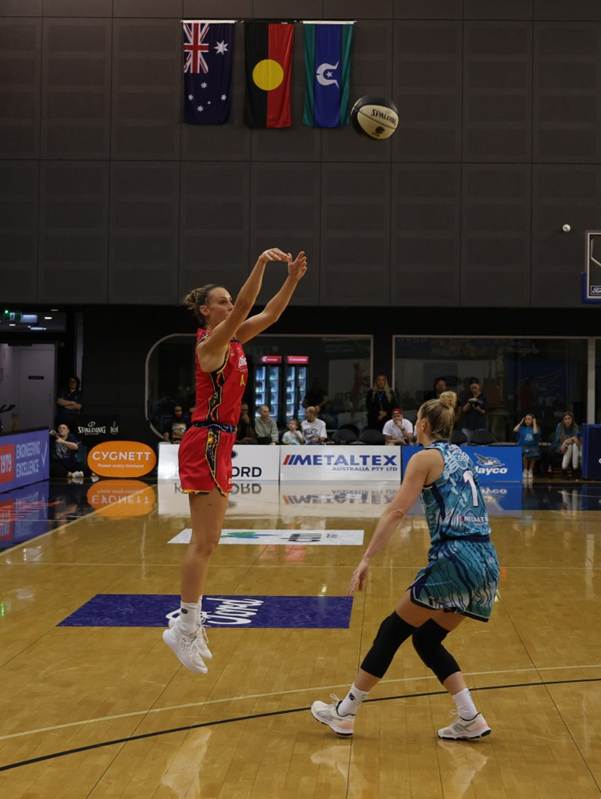
Steph Talbot shooting a three pointer for Adelaide against Southside Flyers at the State Basketball Centre on 6 December 2024
The Opals met Canada again in the bronze medal game. After Australia led Canada 51-43 at half-time the Opals dominated the second half 44-22 to have a 95-65 victory and win the bronze medal. During the bronze medal game against Canada Jackson put on an exhibition to score a phenomenal game-high 30 points at an accuracy of 68.8% from the field in 21 minutes court-time after commencing the game on the bench. At World Cup 2022 Steph Talbot averaged 8.5 points, 6.9 rebounds and 5.3 assists (ranked 4th at the World Cup) per game and played incredible defense to earn selection in the tournament’s All Star Five.
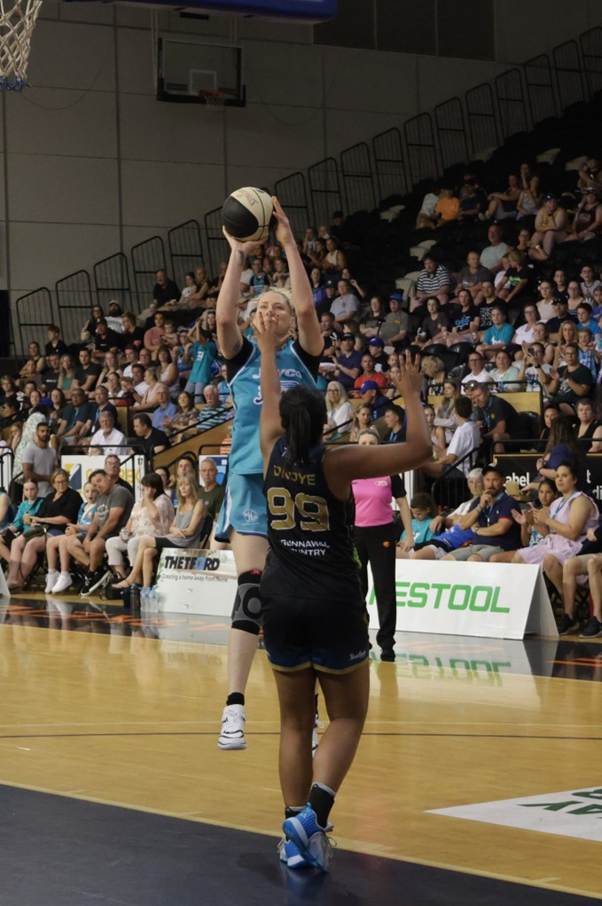
Lauren Jackson making a field goal in Southside Flyers WNBL game against UC Capitals at the State Basketball Centre on 6 January 2024 with Monica Okoye playing defense
The Australian Opals from 2023 to 2026 World Cup Qualifying Tournament
In each of the past three years from 2023 to 2025 the Opals finished on the podium at a FIBA Tournament. Winning the bronze medals at Asia Cup 2023 in Sydney, Australia and the Paris 2024 Olympic Games 2024 and won the gold medal at Asia Cup 2025 in Shenzhen, China. Details of the Opals performances at each of these tournaments as well as World Cup Qualifying Tournament 2026 in Istanbul, Türkiye is provided below.
FIBA Women’s Asia Cup 2023 in Sydney, Australia
The Australian team at the FIBA Women’s Asia Cup 2023 held in Sydney, Australia from Sunday 26 June to Sunday 2 July included a quartet of players from Australia’s bronze medal winning team at Asia Cup 2021 – Keely Froling, Darcee Garbin, Lauren Nicholson and Lauren Scherf. Other members of Australia’s AC 2023 team were Amy Atwell, Chloe Bibby, Shyla Heal, Chantel Horvat, Alice Kunek, Tess Madgen, Anneli Maley and Maddy Rocci. All games during FIBA Women’s Asia Cup 2023 were played at the Sydney Olympic Park Sports Centre (also known as Quaycentre) which was one of the venues for Group games at the FIBA Women’s Basketball World Cup 2022.
Throughout the group stage of Asia Cup 2023 Australia’s starting line-up was Opals captain Madgen, Nicholson, Kunek, Garbin and Scherf. The Opals comprehensively won their first two Group B games, defeating Philippines 105-34 and Chinese Taipei 91-45.
In their third and final Group B game Australia started well to lead 21-15 against Japan at quarter time. Japan dominated the second quarter 29-11 to gain the ascendancy and led 44-32 at half time. Japan won each quarter in the second half by at least six points and recorded a convincing 91-66 victory against the Opals.
Australia finished second in Group B and in a qualification semi final played Korea who had finished third in Group A. The winner of the qualification semi final between the Opals and Korea would advance to the semi finals and in doing so book a ticket to an Olympic Games Qualifying Tournament in February 2024. The Opals made a change to their starting line-up against Korea with Maddy Rocci replacing Nicholson. Australia’s starting line-up for their last three games of the tournament was Rocci, Madgen, Kunek, Garbin and Scherf. Australia gained control early to lead Korea 31-16 at quarter time and went on to win 91-64 and advance to the semi finals.
China outscored Australia 18-11 in the first and third quarters of their semi final to set up a 74-60 victory. In the bronze medal game Australia played Trans-Tasman rivals New Zealand. A strong defensive performance set up Australia’s victory with the Tall Ferns only scoring more than 14 points in one quarter, scoring 17 points in the third quarter. In each of the three other terms New Zealand scored 14 points. By defeating New Zealand 81-59 the Opals won their third consecutive Asia Cup bronze medal.
In a well deserved return to the Opals team Kunek thrived as a starter to average 12.0 points, 4.0 rebounds, 2.0 assists per game and had a three point accuracy of 42.3% to earn selection in the FIBA Asia Cup 2023 All-Star Five.
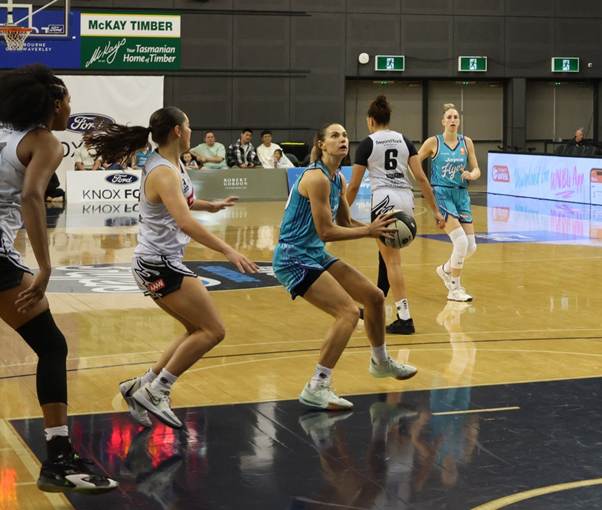
Alice Kunek playing for the Southside Flyers against the Sydney Flames at the State Basketball Centre on 9 November 2024
Kunek was one of eight Opals that averaged at least 6.0 points per game at AC 2023 along with Garbin (10.2 points), Froling (10.0), Rocci (8.8), Madgen (8.7), Scherf (8.5), Heal (7.5) and Maley (6.0). Rocci ranked fourth overall at the tournament with 4.2 assists per game and Madgen was equal fifth with 4.0 assists per game. Scherf and Maley ranked equal first for the Opals and equal seventh overall with 7.5 rebounds per game.
Opals at the 2024 Paris Olympic Games
An experienced Australian Seven Consulting Opals team for the 2024 Paris Olympic Games included nine players that had represented the Opals in multiple major championships led by Lauren Jackson who was competing in her 10th major championship. Opals in the 2024 Paris team joining LJ in this category with multiple major championships were Cayla George (6), Steph Talbot (5), Marianna Tolo (5), Tess Madgen (4), Ezi Magbegor (4), Alanna Smith (3), Sami Whitcomb (3) and Kristy Wallace (2).
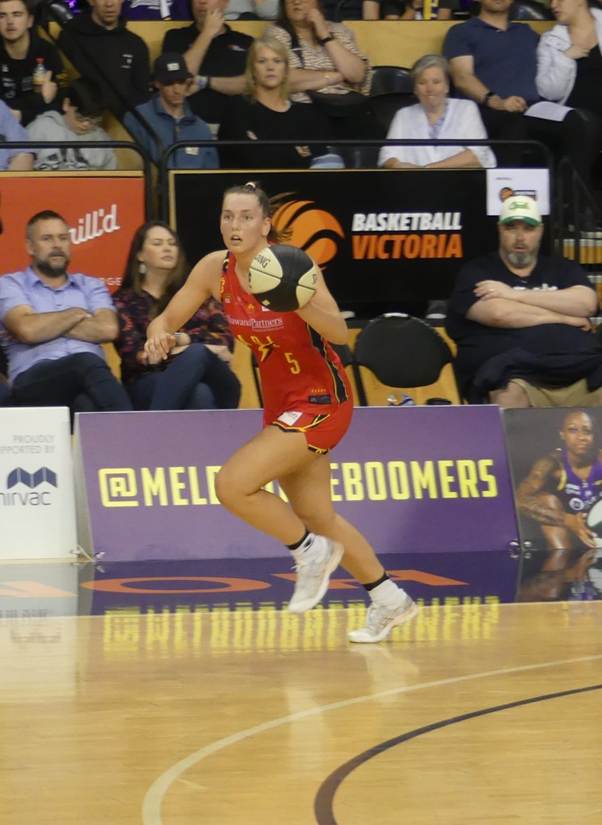
Isobel Borlase playing for Adelaide Lightning against the Melbourne Boomers at the State Basketball Centre on 22 December 2022
The two youngest members of the Opals Olympic Games team, 21 year old Jade Melbourne and 19 year old Isobel Borlase both made their major championship debut in Paris. Melbourne and Borlase were both members of the Australian Gems team that won the silver medal at FIBA Under 19 World Cup 2022 and were roommates at that tournament. Rebecca Allen was named in the Opals team for the 2024 Paris Olympics and was set to represent her nation at a major championship for the fifth time but was a late withdrawal after suffering a hamstring injury in the Opals final warm-up game against Canada. Guard Amy Atwell played in both of Australia’s two warm-up games and was brought into the Olympic Games team to replace Allen and make her major championship debut. Six players from the Opals team three years earlier for the Tokyo Olympics suited up for their nation at the 2024 Olympic Games in Paris – George, Madgen, Magbegor, Smith, Talbot and Tolo.
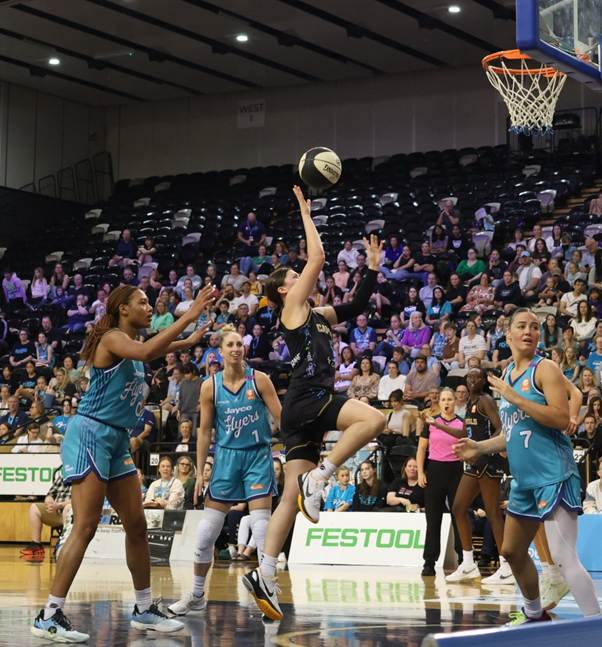
Jade Melbourne playing for the UC Capitals in a road game against Southside Flyers at the State Basketball Centre on 17 November 2024
Australia were in Group B at the women’s 5 on 5 basketball tournament of the 2024 Paris Olympic Games. In their first game of the tournament on Monday 29 July the world number three ranked Opals played 12th ranked Nigeria. The Opals starting line-up was Jade Melbourne and Sami Whitcomb in the back court along with Steph Talbot, Alanna Smith and Ezi Magbegor in the front court. All five Opals starters played in the WNBA in 2024 and a duo, Magbegor and Whitcomb were teammates at Seattle Storm. At the WNBA mid-season break Smith and Magbegor each ranked in the WNBA’s top five for blocks per game and top 20 for rebounds, steals and field goal accuracy.
The Opals were able to build an early 13-5 lead against Nigeria. Momentum quickly shifted with Nigeria going on a 36-15 run for the rest of the first half to lead by 13 points at the main break 41-28. The Opals were able to reduce Nigeria’s lead to two points with over six minutes left in the fourth quarter. Nigeria remain composed and responded well to win by 13 points, 75-62. Critical factors in Australia’s upset loss were making eight of 18 free throws and committing 26 turnovers to Nigeria’s 15. In a starting role Smith was the Opals best player, scoring 15 points at 67% from the field and took seven rebounds. Talbot registered a rebound-assists double-double with 12 rebounds and 10 assists to set game-highs in both categories.
On 1 August the Opals defeated Canada 70-65 to square their ledger at one win and one loss. Key factors in Australia’s victory were a 42-31 rebound advantage and shooting at 48% from the field, a significant advantage over Canada’s accuracy of 35%. Guard Sami Whitcomb shot at 70% from the field, scored an equal game-high 19 points, made a game-high 10 assists, took five rebounds and made two steals in a brilliant all-round game. Five Opals were in double figures for scoring with Whitcomb being joined in this category by Tolo, George and Talbot with 11 points each along with Magbegor with 10 points.
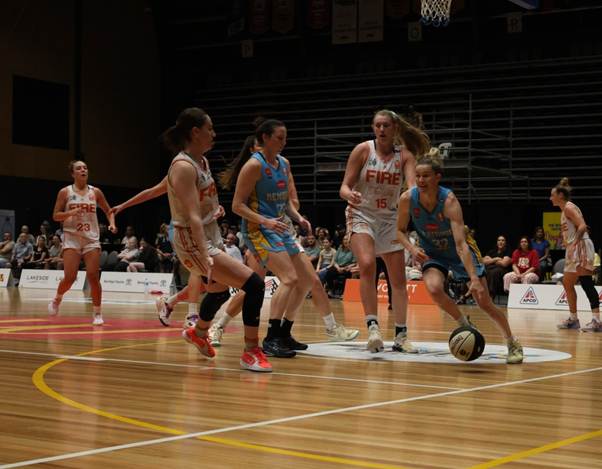
Sami Whitcomb playing for Bendigo Spirit against Townsville Fire at Red Energy Arena on 14 December 2024
Australia’s third and final Group B game was at 9.00 pm Sunday 4 August Paris time, 5.00 am Monday 5 August AEST against host nation France who had qualified for the quarter finals. France had been one of the form teams of the tournament to that stage, winning their first two games against Canada and Nigeria with the same score 75-54. If Australia lost to France they would miss out on the quarter finals and would be eliminated from the tournament. An Opals victory would result in Australia, France and Nigeria having a record of two wins and one loss. Points differential in the head-to-head games between these three nations would be required to rank them from first to third in Group B. In head-to-head games between the three nations the points differential before the game between France and Australia was, France +21, Nigeria -8, and Australia -13. If Australia defeated France by four points or less the order would remain the same with France first, Nigeria second and Australia third. If Australia defeated France by six points or more they would finish second and Nigeria third. An Opals victory against France by 18 points or more would enable them to overtake France and finish first. A five point win by Australia would have them tied with Nigeria for points difference and a 17 point win would have Australia tied for points differential with France. In either of these two instances the team that had the higher total points scored in the head-to-head games would be ranked higher.
The first half between host nation France and Australia was an arm wrestle with the scores locked at 34 points apiece at half-time. Opals captain Tess Madgen made a three-pointer to extend the Opals lead to four points with two minutes and 47 seconds remaining in the third quarter. Less than a minute later Madgen made the next score of the game, another three-pointer to extend the Opals lead to seven points. France fought back to reduce the margin to one point midway through the last quarter. Again Madgen played a critical role in extending Australia’s margin to the required six points. Madgen cut to the basket, received a pass from Magbegor and made a lay up to increase the Opals lead to three points, 67-64. Madgen provided an assist for a George three-pointer to extend the Opals lead to six points, 70-64 with three minutes and 48 seconds left in the fourth quarter. Just under three minutes later a Gabby Williams three-pointer reduced Australia’s lead to five points, 72-67. On the next possession Whitcomb made a pull-up jump shot to increase Australia’s lead to seven points, 74-67 with 43 seconds. Marine Johannes answered with a step back three-pointer to trim the margin to four points, 70-74 with 33 seconds left, leaving Australia with some work to do to advance to the quarter finals. The Opals scored the next four points of the game comprised of a George pullup jump shot and two free throws made by Talbot to increase the lead to eight points 78-70 with 11 seconds left. France quickly responded with a lay up by Marieme Badiane from a Williams assist to reduce the margin to six points with four seconds. After the Opals inbound George was fouled. In her trip to the foul line George made her first free throw, missed the second and the Opals recorded a thrilling seven point victory, 79-72 to advance to the quarter finals.
In a must win game against France, Opals captain Madgen made four of six three-pointers at an accuracy of 67%, scored a game-high 18 points at 67% from the field, took three rebounds and played 30 minutes and 41 seconds court time off the bench. Madgen accounted for two thirds of the Opals three-pointers with entire team making six three-pointers. Post game Opals starter Melbourne commented “Madgen, whenever we needed a three, she hit one.” Madgen was one of four Opals that reached double figures in scoring and had a field goal accuracy of at least 50%, being joined in this category by Magbegor – 14 points at 50%, Smith – 12 points at 75% and Whitcomb – 12 points at 71.4%. Australia won the assist count 22-16 with Whitcomb making a game-high seven assists.
During an interview on Channel 9 after the Opals win against France Andrew Gaze asked “Hey Tess, what a game, very emotional, you were clearly aware of what you had to do to try and avoid the USA but most importantly was the win.” Madgen responded “Yeah absolutely, we honestly didn’t have anything in our minds besides winning the game. We got ourselves in a bit of trouble against Nigeria, they’re having a great tournament, all credit to them. I am just so proud of the girls, one point, six points I am just so happy with the win.” Gaze said “We are proud of every one of you but more importantly we are proud of you in a green and gold jersey, I have not seen a more impressive performance when the game has been on the line and what you had to do knocking down the shots and under enormous pressure, they were up the court pressuring the whole game.” Tess replied “Yeah, the coaches put together a really good game plan, we knew they would be up all night for 40 minutes and knew if we took care of the ball, took good shots and won the rebounds we would be in really good shape. I am the captain of this team, it is a huge responsibility and one I take with great pride so I was absolutely going to leave everything out there on the floor tonight.”
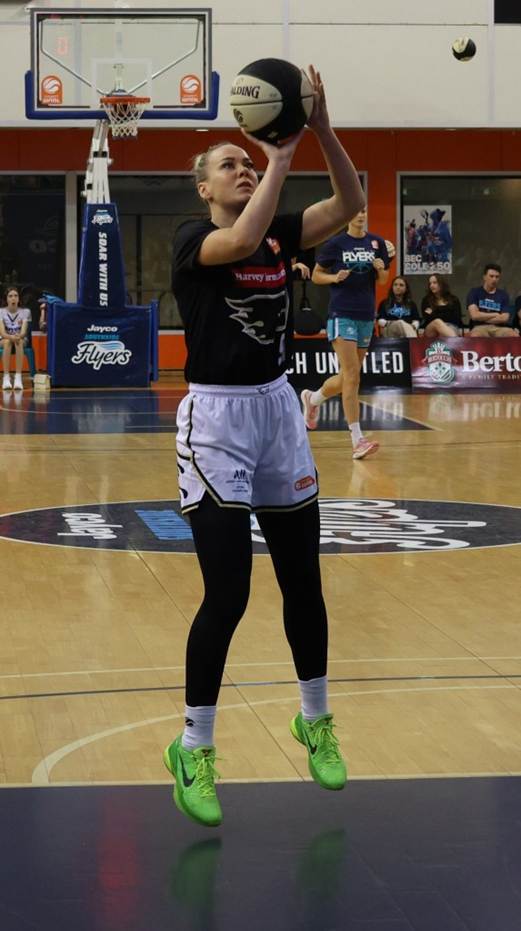
Tess Madgen during the warm-up for Sydney Flames game against Southside Flyers at the State Basketball Centre on 12 January 2024
For a quarter final the Opals were drawn to play Serbia, the nation that ended the Opals Olympic Games at the same stage of the tournament, eight years earlier at Rio 2016. In a men’s basketball quarter final at the 2024 Paris Olympics Serbia defeated the Australian Boomers 95-90 in overtime.
During their quarter final in Paris the Opals gained the ascendancy in the first half to lead Serbia 48-32 at half-time. Australia went on to win by 18 points, 85-67 to progress to the medal games for the seventh time overall in the women’s basketball five on five tournament at the Olympics and first time since the London 2012 Olympic Games. The only player on the Opals 2024 Olympic team that had won an Olympic medal was Lauren Jackson, having won three silver medals, 2000, 2004 and 2008 along with a bronze medal in 2012. In the Opals victory against Serbia Smith shot at a proficient 53.8 % from the field and recorded a double-double comprised of 22 points and 13 rebounds to set game-highs in both categories. Point guard Melbourne played her best game of the tournament to score 18 points at 66.7% from the field and made an equal game-high five assists. Off the bench George scored 18 points at 50% from the field. Whitcomb scored 15 points and the Opals four highest scorers accounted for 73 of their nation’s 85 points. Australia won the rebound count against Serbia 43-32 and had the superior field goal accuracy, 46% to 39%.
In a semi final the United States dominated the second quarter 25-11 to set up an 85-64 victory against the Opals. Starter Talbot aggravated a foot injury in the first half and didn’t play in the second half. Madgen commenced the second half on the court, replacing Talbot. Three Opals reached double figures in scoring against USA, first time Olympian Borlase with 11 points followed by Madgen and Tolo with 10 points each. Smith made three of her four field goal attempts at an accuracy of 75%, scored seven points and took a team-high seven rebounds.
The later semi final was host nation France against Belgium. In overtime France prevailed to have an 81-75 victory to progress to the gold medal game against the United States. For their first five games of the tournament Australia had the same starting line-up however one of the starters Talbot had been restricted by a planter fascia injury. For the bronze medal game against Belgium Talbot was replaced in the starting line by Opals captain Madgen who joined Melbourne, Whitcomb, Smith and Magbegor in her nation’s starting quintet. Belgium were competing in the women’s basketball 5 on 5 tournament for the second time, having finished seventh at the Tokyo 2020 Olympics. At the end of each of the first three quarters of the semi final between Australia and Belgium the margin was one point. The Opals led by a point at quarter time and half time and Belgium led by a point at three quarter time.
A step back three pointer by Julie Vanloo on the first possession of the final quarter extended Belgium’s lead to four points. A three-pointer by Madgen with seven minutes and eight seconds left in the fourth quarter resulted in Australia taking a 68-66 lead. Vanloo responded on the next possession, making a three-pointer to regain a one point lead for Belgium. Australia scored the next eight points of the game comprised of two free throws by Smith, a free throw by Talbot, a layup by Magbegor and a three-point play by Smith to lead 76-69 with four minutes and eight seconds to play in the stanza. For the remainder of the game Belgium twice reduced the margin to three points, on both occasions Opals captain Madgen made the next score of the game. With two minutes and 41 seconds left in the fourth quarter Madgen made a three-pointer to increase Australia’s lead to six points, 79-73. A made three pointer by Antonia Delaere reduced Australia’s lead to three points, 81-78 with one minute and five seconds left in the fourth quarter. 40 seconds later Delaere attempted another three-pointer, however Talbot at full stretch displayed great timing and judgement to block the shot. After a shot clock violation by Belgium Vanloo fouled Madgen with 15.8 seconds left with the Opals leading by three points 81-78. Madgen made two free throws to extend the lead to five points, 83-78. Madgen was fouled with 6.9 seconds left and made both free throws to extend the Opals lead to seven points 85-78. On the final buzzer Vanloo made a three-pointer to reduce the margin to four points, 85-81.
After losing their opening game of the tournament to Nigeria and narrowly making it to the quarter finals Australia improved as the tournament progressed to finish on the podium and win the bronze medal. On making free throws late in the bronze medal game against Belgium Madgen commented “Honestly, I was pretty nervous. It was probably the most nervous I’ve ever been to shoot. As the crowd got louder….that kind of egged me on to make it. All I could think of was shutting the crowd up.”
With the stakes at their highest Magbegor played an incredible game to make 12 of 17 field goal attempts at an accuracy of 70.6%, score a game-high 30 points, take a game-high 13 rebounds, made three assists, had three blocked shots and two steals in the victory against Belgium. With a medal on the line Magbegor rose to the occasion to deliver an “All-Time Women’s Olympic High 45 efficiency” and Ezi was joined in double figures for scoring by Whitcomb (14 points), Smith (13) and Melbourne (10). Smith took 12 rebounds to record a double-double and Melbourne made a team-high seven assists. Australia had a significant advantage on the boards, winning the rebound count 42-27 against Belgium. The Opals made 24 assists and had 11 turnovers.
At the Paris Olympic Games seven Opals averaged at least 17.0 minutes per game led by Whitcomb with 31.3 minutes per game. Magbegor, Talbot, Madgen, Melbourne, Smith and George all averaged between 17.0 and 26.0 minutes per game. Five of these seven players are in the Opals team for World Cup 2026 in Berlin. The exceptions are Madgen, having retired after the Paris Olympics and Whitcomb, missing WC 2026 due to a knee injury.
Whitcomb led Australia with 13.0 points per game at the 2024 Paris Olympics, ahead of Smith and Magbegor in equal second place with 11.5 points. Eight Opals averaged at least 5.0 points per game with other players in this category being Madgen (7.5), Melbourne (7.0), George (7.0), Talbot (5.7) and Tolo (5.0). The Opals leading rebounders were Smith (8.0 rebounds per game), Talbot (7.5) and Magbegor (6.0). Whitcomb led Australia with 5.3 assists ahead of Talbot (4.5) and Melbourne (2.8).
At the 2024 Paris Olympics Smith started all six games for the Australian Opals, had a field goal accuracy of 52.0%, three-point accuracy of 41.7% and averaged 11.5 points (ranked equal 2nd for the Opals), 8.0 rebounds (1st) and 1.2 steals per game. Smith was recognised for her outstanding tournament by being selected in the All-Star Five at the FIBA 2024 Paris Olympic Games. Magbegor was selected in the Paris Olympics All-Second Team after having a field goal accuracy of 50.9% and averaged 11.5 points (ranked equal 2nd for the Opals), 6.0 rebounds (3rd) per game and 1.5 blocked shots (1st) per game.
Opals at FIBA Women’s Asia Cup 2025 in Shenzhen, China
When Basketball Australia announced the Seven Consulting Opals FIBA Women’s Asia Cup 2025 team on 23 May 2025 the 12 player team only included two players from Australia’s bronze medal winning team at Asia Cup 2023 in Sydney, Maddy Rocci and Chloe Bibby. The Opals had a setback with Rocci being ruled out of AC 2025 on 7 July due to injury. A quartet in the Opals Asia Cup 2025 team had represented Australia at a previous edition of the tournament – Sara Blicavs (2017 & 2019), Cayla George (2019), Zitina Aokuso (2021) and Bibby (2023). Six players in the Australian Opals Asia Cup 2025 team had represented Australia before 2025 with Reid and Borlase joining the four players named above in this category. For Asia Cup 2025 George was named captain and Blicavs was appointed vice-captain.
Five members of the Australian Opals bronze medal winning team from the Paris 2024 Olympic Games were unable to be considered for Asia Cup 2025 due to WNBA commitments – Ezi Magbegor (Seattle Storm), Jade Melbourne (Washington Mystics), Alanna Smith (Minnesota Lynx), Steph Talbot (Golden State Valkyries) and Sami Whitcomb (Phoenix Mercury). Due to WNBA commitments as the Head Coch of New York Liberty in the WNBA Opals Head Coach Sandy Brondello was unavailable for Asia Cup 2025. Opals Associate Head Coach Paul Goriss was the Head Coach at AC 2025. Two members of the bronze medal winning team at the Paris 2024 Olympic Games that represented Australia at AC 2025 were guard Isobel Borlase and frontcourt player Cayla George.
The Opals FIBA Women’s Asia Cup 2025 team had less experience representing their nation at senior level in five on five basketball at international tournaments than a typical Opals team. This was highlighted by the fact that six members of the Australian AC 2025 team were yet to make their Opals debut at the end of April 2025. A quartet of players – Abbey Ellis, Alex Fowler, Courtney Woods and Miela Sowah made their debut for the Australian Opals in the Trans-Tasman Throwdown against New Zealand in May during a three game series and all represented the Opals at Asia Cup 2025. Ellis was a late inclusion at AC 2025 for the injured Rocci. Less than a year after making their Opals debuts together the quartet of Ellis, Fowler, Woods and Sowah were all teammates and starters on the Townsville Fire team that won the 2025/26 WNBL championship. A former Townsville Fire player Steph Reid was named the Opals captain for the Trans-Tasman Throwdown against New Zealand in May 2025, a magnificent achievement, especially for someone who couldn’t break through to represent their state let alone their country at junior level. A duo in Australia’s 2025 Asia Cup team – Isabelle Bourne and Ally Wilson made their Opals debut in China in warm-up games for Asia Cup 2025.
From Sunday 13 July to Sunday 20 July the FIBA Women’s Asia Cup 2025 was held in Shenzhen, China. Australia had competed at four previous Asia Cups from 2017 to 2023 and had finished on the podium each time but were yet to win the gold medal, having won the silver medal in 2017 followed by a hat-trick of bronze medals in 2019, 2021 and 2023.
The Opals starting line-up throughout Asia Cup 2025 in Shenzen, China was Reid, Borlase, Fowler, Blicavs and George. Six players – Aokuso, Bibby, Bourne, Ellis, Sowah and Woods all played court time off the bench in the opening game. Due to a knee injury guard Wilson didn’t play. Australia recorded a convincing 115-39 victory against the Philippines and were at their most dominant in the fourth quarter, winning the term 28-2. All 11 players that had court time for Australia scored at least four points led by Sowah with a game-high 19 points at an accuracy of 70% from the field. Six Australians were in double figures in scoring including Blicavs with 17 points and Bibby with 16 points at 70% from the field. Australia’s only remaining player from Asia Cup 2023 – Bibby recorded a double-double, taking an equal game-high 10 rebounds (along with Opals captain George) playing 19 minutes and 54 seconds off the bench. Two point guards, Reid and Ellis that were teammates for NBL1 South club Diamond Valley Eagles in 2025 each made an equal game-high nine assists for the Opals against the Philippines.
The Opals had their second consecutive win by more than 70 points at Asia Cup 2025, defeating Lebanon by 79 points, 113-34. All 10 Opals that played court time played between 17 and 23 minutes and scored at least seven points, led by Bourne with 15 points in her first senior FIBA five on five tournament. Bibby recorded her second double-double of the tournament, scoring 12 points at 71.3% from the field and took a game-high 12 rebounds. Australia won the assist count against Lebanon 39-7 and three Opals made at least six assists each, Reid and Woods with an equal game-high seven assists each along with Fowler with six assists.
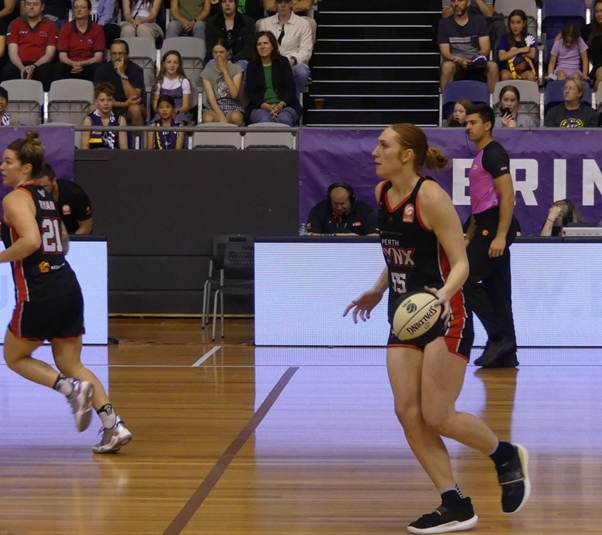
Chloe Bibby playing for Perth Lynx against the Melbourne Boomers at Melbourne Sports Centres Parkville on 29 January 2023
The Opals third and final Group B game against Japan on Tuesday 15 July was likely to determine which team finished on top of the group and advanced directly to the semi finals. Both teams had won their first two games at the tournament against Philippines and Lebanon however Japan were unable to maintain the same standard they had played at during recent Asia Cups. Australia’s aggregate winning margin from their first two games was 155 points whilst Japan’s combined winning margin against the same opponents was just seven points. Japan won their first game of Asia Cup 2025 against Lebanon 72-68 and followed this up with an 85-82 victory against the Philippines.
Australia were favourites for their final group game against Japan due to their better form early at Asia Cup 2025 however Japan with their speed and three-point shooting had posed match-up problems for the Opals at previous editions of the tournament. Japan’s starting five for the group game against the Opals was Norika Konno, Stephanie Mawuli, Maki Takada, Ramu Tokashiki and Kokoro Tanaka. Australia started the 2025 group game well to lead Japan by four points, 26-22 at quarter time. Japan made four three pointers in the second quarter including two in the first 40 seconds of the term and outscored Australia 29-16 in the stanza to turn a four point quarter time deficit into a nine point half time lead 51-42.
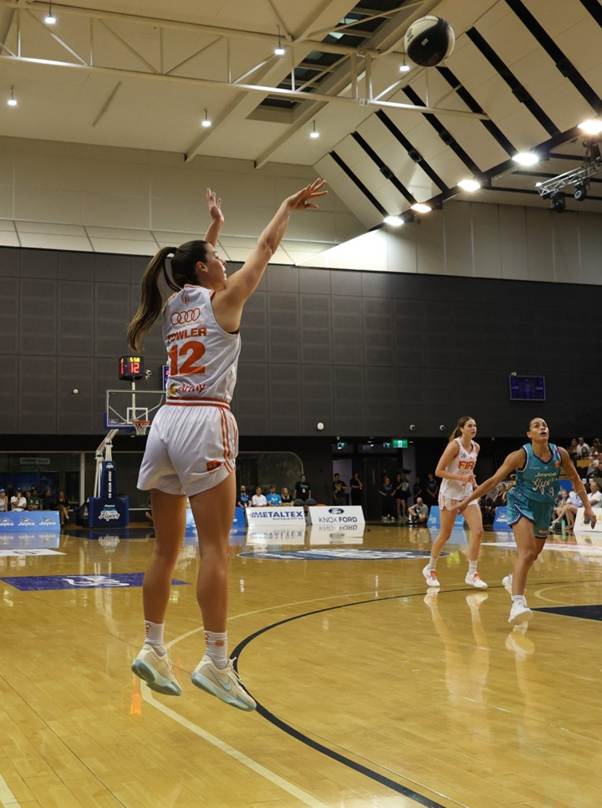
Alex Fowler shooting a three-pointer playing for Townsville Fire against the Southside Flyers at the State Basketball Centre on 4 January 2025
Australia responded in emphatic fashion to restrict Japan to just 16 points in the second half comprised of eight points in each quarter. The Opals scored 37 points in the second half to win the game by 12 points, 79-67. Australia utilised their size advantage over Japan to win the rebound count 44-32. Reid scored a team-high 15 points at 60% from the field and made a game-high nine assists. Aokuso scored 14 points at 66.7% from the field and took a game-high eight rebounds. The Opals quartet of double figure scorers was completed by Bliacvs (13) and Fowler (11). For Japan Mawuli scored a game-high 19 points at 54.5% from the field. Tanaka ranked second for Japan with 10 points and made a team-high five assists. Takada took six rebounds to be the only Japanese player with more than three boards.
In a semi final against Korea the Opals opened up a nine point lead at quarter time 22-13. For the second game in a row Australia were outscored in the second quarter, Korea took the honours for the term 25-20 to reduce the deficit to four points at half time. Korea scored the first two field goals of the third quarter to level the scores at 42-42 apiece with eight minutes and 37 seconds remaining in the third term. The Opals went on a 13-2 run to regain the ascendancy and led 55-44 with four minutes and 51 seconds left in the third stanza. The Opals went on to defeat Korea 86-73 to advance to the Asia Cup final for the second time, having won the silver medal the first time they competed at the tournament in 2017. The Opals most experienced player, George shot at a team-high 60% from the field, scored an equal game-high 20 points along with Korea’s Yeeun Heo and took a game-high 13 rebounds. Five Australians scored between nine and 14 points against Korea comprised of Blicavs (14), Bibby (12), Fowler (11) and Reid (9). Again Reid led the Opals with eight assists, Fowler ranked second in this category with four dimes.
In a semi final Japan upset host nation China 90-81 to progress to the final and played the Opals for the second time at the tournament. For the final Australia and Japan both had the same starting quintets they had for their group game against each other. Four minutes into the first quarter of the final Japan led 10-8 with Tanaka scoring five points. The Opals went on a 10-0 run to establish an eight point lead with three minutes and 28 seconds left in the first term and went on to lead 54-43 at half time. Japan won a low scoring third quarter 16-13 to reduce the deficit to eight points at three quarter time. Japan had the better start to the fourth quarter and levelled the scores twice, at 70 all and 73 points apiece with six minutes and 19 left in the stanza but were unable to take the lead. Before the final Wilson had played less than 10 minutes in total for the tournament due to a knee injury. Despite this Wilson made a massive impact in the fourth quarter of the final. An Australian unanswered seven point run comprised of a lay-up by Wilson, a three-pointer by Reid and another lay-up by Wilson gave Australia an 80-73 lead with four minutes and 11 seconds left in the fourth quarter. Australia defeated Japan 88-79 to win the gold medal with Wilson scoring 13 of her 14 points for the game in an exceptional final quarter.
Fowler scored a team-high 15 points and took a game-high six offensive rebounds. Aokuso took a team-high eight rebounds and ranked equal second with Reid with four assists. Opals captain George made a team-high five assists. Joining Fowler and Wilson in double figures for scoring were Reid (13) and Aokuso (11). Tanaka scored 21 points for Japan and made nine assists to register game-highs in both categories. Off the bench Miyazawa scored 18 points and made a game-high nine assists. The rebound count was far closer in the final with Australia having a narrow advantage 39-38. The Opals had 22 assists to Japan’s 15 and handled the ball better to have nine turnovers to Japan’s 17.
After Australia defeated Japan in the final to win the gold medal Opals Coach Goriss commented “We knew coming in that Japan had a huge win last night against China and that they’re gonna be a formidable opponent. I think that our team and the players really bought into the game plan. Really happy and proud of the team for their efforts this whole week.”6
FIBA Women’s Basketball World Cup 2026 Qualifying Tournament in Istanbul, Türkiye
The Seven Consulting Australian Opals are one of six nations competing in a FIBA Women’s Basketball World Cup 2026 Qualifying Tournament for a week from Wednesday 11 to Tuesday 17 March local time in host city Istanbul, Türkiye. The Opals are ranked second in the world and play five games at WCQT 2026, against in chronological order, Argentina (ranked 27th in the world), Japan (11), Hungary (20), host nation Türkiye (16) and Canada (7).
Basketball Australia announced an extended 19 player Australian Opals squad on 20 December 2025 in the lead up to the FIBA Women’s Basketball World Cup – Qualifying Tournament 2026 to be held in March. Australian Opals Head Coach Sandy Brondello commented “Availability is hugely important and honestly, a luxury we don’t often have in the international space. Having full access to the talent pool gives us real clarity and confidence. It allows the staff and I to evaluate the group together, accelerate connection and trust, test roles and versatility, and ultimately strengthen the foundation we’re building toward the FIBA Women’s World Cup.”7
Seven members of the Opals bronze medal winning team at the Paris 2024 Olympic Games suited up for their nation in Istanbul – Isobel Borlase, Cayla George, Ezi Magbegor, Jade Melbourne, Alanna Smith, Steph Talbot and Sami Whitcomb. Five players that didn’t represent Australia at the 2024 Paris Olympic Games and were members of the Opals gold medal winning team for Asia Cup 2025 were selected for WCQT 2026 – Zitina Aokuso, Chloe Bibby, Alex Fowler, Steph Reid and Ally Wilson. Borlase and George are the only two players that were members of the Opals team for both the 2024 Olympic Games and 2025 Asia Cup.
Three of the members of the Opals bronze medal winning team at the 2024 Paris Olympic Games weren’t available for WCQT 2026 in Istanbul, Türkiye. Madgen and Jackson both retired after the Paris 2024 Olympics. Tolo was pregnant with her first child, and her last game of the 2025/26 season was the 250th game of her WNBL career, a milestone she shared with Bendigo Spirit teammate Kelsey Griffin. A duo from the Opals 2024 Olympic games team were overlooked for WCQT 2026, Amy Atwell and Kristy Wallace. Atwell was part of the Opals extended 19 player squad but was cut from the final team of 12 players. Atwell and Wallace have both represented the Australian Gangurrus women’s 3×3 team at FIBA tournaments in 2026. Wallace and Atwell were teammates on the Gangurrus Women’s 3×3 team that won the gold medal at Asia Cup 2026.
Sami Whitcomb was announced as The Seven Consulting Australian Opals captain in Istanbul, Türkiye. Whitcomb addressed the Opals players and staff and in a post made on the Seven Consulting Opals Instagram account commented “We all said it the other day, it is so special to be an Opal at any stage but I think right now we are so lucky to be Opals with where we are at as a group with how much work has been done. I would be remiss to not shout out Tess Madgen for that. Obviously it is everybody in this room, people have been a part of it for a long time but I know in particular I learned so much from her and so much of what she has poured into where we are now, in terms of legacy top the Opals and legacy of Opals leadership we are so privileged to be a part of this group now in that stage where we have all experienced her leadership or we are getting to experience it now. That is her legacy, this beautiful culture that she has created.”
In an article titled ‘More pace and space: Brondello’s goals for Opals’ World Cup Qualifiers’ published BY ESPN on 10 March 2026 and written by Megan Hustwaite Brondello told ESPN “We’ve got to make the most of the time we have, five games and it’s an opportunity for us to find our chemistry, be reunited and get back playing Opals basketball. We know we have limited time together, it’s normal for us and it is what it is. We’ve got different opponents and that’s the beauty of this tournament. It’s not Asia Cup, we’ve got one Asian team and every country has a different style so it’s about us needing to adapt against different styles but also bringing our own identity. It’s getting everyone up to speed again and seeing what we need to work on as we move forward towards the World Cup. The luxury is that we have qualified but we still want to win, work out what combinations work well together and what areas we need to focus on a little bit more over the coming months.”8
The Seven Consulting Australian Opals commenced their FIBA WCQT 2026 against Argentina in the opening game of Day 1, Wednesday, March 11. Australia’s starting line-up included a quartet from their bronze medal winning team at the Paris 2024 Olympic Games – Whitcomb, Talbot, Magbegor and Smith. A new addition to the Opals starting line-up was guard Ally Wilson who made her Opals debut less than 12 months earlier and was a member of Australia’s gold medal winning team at Asia Cup 2025. All seven players that commenced the Opals game on the bench against Argentia played court time and had represented their nation at the 2024 Paris Olympic Games and / or Asia Cup 2025. Borlase and George were the only two players that represented the Opals at both tournaments and were joined by fellow Paris 2024 Olympian Melbourne on the bench. AC 2025 Opals team members Aoksuo, Bibby, Fowler and Reid commenced the game against Argentina on the bench.
In the opening game in Istanbul, Türkiye the highest ranked team at the tournament, the world number 2 Australian Opals played the lowest ranked team, Argentina who were ranked 27th in the world. On paper it looked to be a lopsided contest, the Argentinian team had a very different idea and after Diana Cabera made a floating jump shot with four minutes and 17 seconds left in the first quarter they led the more fancied Opals 12-10. The Opals were able to regain the lead but with six minutes and 19 seconds remaining in the second term only one field goal separated the two teams with Australia leading Argentina 33-31. For the rest of the first half the Opals dominated to go on a 18-5 run to lead by 13 points 49-36 at half time. The Opals weren’t threatened in the second half and recording a convincing 26 point win, 91-65. All 12 Opals scored at least three points led by Borlase who made three of five three-pointers at an accuracy of 60% and scored 19 points at 75% from the field in 16 minutes and 57 seconds, equating to more than a point per minute played. Magbegor shot efficiently to make five of six field shots at an accuracy of 83.3% from both the field and the free throw line to score 16 points with one FG being a three-pointer. Magbegor took an equal team-high seven rebounds, made three steals, two assists, blocked one shot and didn’t commit any turnovers to be named the TCL Player of the Game. Off the bench Melbourne was efficient to make both three-point attempts, score 12 points at 66.7% from the field and make three assists. Smith had a quieter game from a scoring perspective with four points bud made an impact in other facets to take an equal game-high seven rebounds and made a team-high five assists.
For the second game against Japan on 12 March the Opals made one change to their starting line-up with Melbourne moved into the starting line-up and Wilson commencing the game on the bench. With two and a half minutes left in the first quarter the ties were locked at 18 points apiece. In the last minute and 50 seconds of the opening stanza the Opals gained the ascendancy with a 7-0 run comprised of Aokuso making a field goal after taking an offensive rebound, Whitcomb making a three-pointer and Fowler making a layup. Japan flipped the script at the start of the second term to have an 20-3 run to build a 10 point lead 38-28 with five minutes and 50 seconds left in the opening half. It was fairly even for more than a quarter and a half and Japan looked to be in a strong position leading by nine points 69-60 with seven minutes and 20 seconds left in the last quarter. Japan’s lead had been reduced to six points half-way through the last quarter and there was a big momentum shift with Talbot making corner threes on back-to-back possessions to level the scores on 70 points apiece with four minutes and 15 seconds to play. The next two field goals of the game were also Opals three-pointers for Smith and Melbourne and suddenly Australia had a five point lead 76-71 with two minutes and 30 seconds remaining in the fourth quarter. In the final two minutes Magbegor scored the last five points of the game with a lay up and a three-pointer as the Opals secured a 10 point victory 81-71. Amazingly the Opals outscored Japan by 19 points in the last quarter, 23-4. The Opals dominated the boards to win the rebound count 51-27 and blocked eight shots compared to Japan’s one.
Opals captain Whitcomb was named the TCL Player of the Game, making six of 10 field goal attempts at 60%, four of seven three-pointers at 57.1%, scored an equal game-high 17 points, took five rebounds and made a team-high two steals. Front court duo Magbegor and Smith scored 14 points and 12 points respectively and each shot at 50% from the field. Smith took a game-high nine rebounds and Talbot ranked second in this category with eight boards. Off the bench Wilson made a team-high seven assists. Three players for Japan scored at least 16 points, starting duo Kokoro Tanaka (17 points) and Aika Hirashita (16) along with Mai Yamamoto with 16 points off the bench. Point guard Machida took a team-high six rebounds and made a game-high 10 assists.
After the Opals 10 point victory against Japan Whitcomb commented “We really liked the grit that we showed in that second half, in particular that fourth quarter. Japan’s a great team and they made a really great run after I thought we started the game pretty well. Things weren’t going our way. We’d make a run and then they’d hit a couple of tough threes, but I thought we did a great job of hanging in there and fighting defensively. Talbs (Steph Talbot) hit a couple of really huge threes and that brought us back in.”9
On being tested by Japan and fighting back to get the victory Opals Head Sandy Brondello said “It was a great hit-out for us. I explained to them that Japan were going to have some urgency because they need to win. They’re trying to qualify and do something big here. You’re not always going to have a great first half at a tournament, but we found some grit in that third quarter, and the group we had on the floor were elite defensively. Our defence created our offence, and that is our identity.”10
For the Opals third game of WCQT 2026 against Hungary Wilson returned to the starting line-up and Melbourne commenced the game on the bench. Whitcomb, Talbot, Magbegor and Smith retained their position in Australia’s starting five. Australia and Hungary were evenly matched for just over a quarter with the scores being locked at 17 points apiece with seven minutes and 40 seconds remaining in the second term. A 9-0 Opals run in just over two minutes opened up a 26-17 lead with five minutes and 30 seconds to play in the second term. The Opals led 40-33 at half time and outscored Hungary 17-10 in the third quarter to extend their lead to 14 points at the last change. Australia recorded a 71-58 victory and outscored Hungary by at least seven points in the 2nd and third quarter. Hungary bookended the game by outscoring the Opals by a solitary point in both the first and last quarters. A quartet of Opals scored at least 12 points led by Magbegor with a team-high 14 points, Aokuso with 13 points off the bench and Smith and Whitcomb with 12 points each. Aokuso took a game high nine rebounds and shot at 60% from the field.
At World Cup 2022 and Asia Cup 2023 the Opals had the benefit of playing on home soil and having strong crowd support. For the fourth game at WCQT in Istanbul the Opals were opposed to host nation Türkiye who were ranked 16th in the world, 14 positions lower than Australia. Due to a foot injury Magbegor didn’t play against Türkiye or in the final gama against Canada and was replaced in the starting line-up by Aokuso. For second game in a row the Opals lost the first and fourth quarters to Türkiye but outscored their opponent in the second and third quarters. Olcay Cakir made a pullup jump shot for Türkiye 15 seconds into the game to open the scoring. Türkiye led by five points at quarter time, 24-19 and got the opening score of the second quarter with a lay up to extend their lead to seven points 29 seconds into the term. The Opals outscored Türkiye 21-18 in the second quarter and 18-12 in the third quarter to lead by for points, 58-54 at three quarter time. 49 seconds into the fourth term Cakir made a floating jump shot to open the scoring for the final quarter and reduced the Opals lead to two points. Türkiye opened the scoring in each of the four quarters and in three terms it was Cakir who scored the opening basket. The Opals steadied to score the next six points with George making a three pointer and Smith scoring three points the old fashioned, getting fouled whilst making a lay up and then made the free throw. After trailing by nine points, 64-73 with one minute and 55 seconds left in the fourth quarter Türkiye went on a 7-0 run culminating with a Kennedy Burke lay up to reduce the deficit to two points, 71-73 with 21 seconds remaining on the clock. Talbot was fouled and made both free throws to increase the Opals lead to four points with 20 seconds left. A layup by Uzun reduced Türkiye’s deficit to two points however Wilson responded with a layup of her own four seconds later to restore the Opals lead to four points. Australia recorded a three point victory, 74-77 against host nation Türkiye.
In the victory against Türkiye Smith was named the TCL Player of the game, scoring a team-high 18 points at 53.8% from the field and took a game-high 10 rebounds comprised of five defensive and five offensive. Three of Smith’s teammates made five assists each and joined her in double figures for scoring, George with 16 points off the bench along with starting duo Wilson (14 points) and Whitcomb (11). Türkiye made 17 turnovers to the Opals 15 turnovers however Türkiye’s turnovers were far more costly with the Opals scoring 23 points off turnovers, 14 points more than Türkiye’s nine points off turnovers.
Magbegor and Talbot didn’t play in Australia’s final game of WCQT 2026 against Canada. The Opals starting five was Wilson, Whitcomb, Borlase, Smith and George. For the third game in a row Australia outscored their opponent in two of the four quarters and were outscored in two of the four quarters. Despite conceding the opening basket of the game to a Bridget Carleton fade away jump shot the Opals led Canada 20-15 at quarter time. Canada regained the lead 39-37 with one minute and eight seconds left in the half. On the next possession Opals captain Whitcomb made a three-pointer to regain the lead for Australia by one point in what ended up being the final score of the game.
Whitcomb scored a game-high 23 points, at 66.7% from the field and put on a long range shooting exhibition to make all five three point attempts. Fellow starters Borlase (13 points) and Smith (12) were also in double figures. Smith took a team-high eight rebounds and fellow forward Bibby ranked second for the Opals in this category with seven boards. Whitcomb made a team-high five assists.
At WCQT 2026 the Opals won all five games and their captain Whitcomb ranked first with 26.6 minutes per game and Smith (26.0 minutes per game) was the only teammate to average more than 25 minutes per game. Five Opals averaged between 18.0 and 23.0 minutes per game – Wilson, Talbot, Magbegor, George and Melbourne. Magbegor ranked first for the Opals with 14.7 points per game at 57.1% from the field. Four Australian’s averaged double figures in scoring with Magbegor joined in this category by Whitcomb (13.8 points), Smith (11.6) and Borlase (10.4). Wilson ranked first for Australia with 3.8 assists per game, ahead of Magbegor (2.7) and Melbourne (2.4).
Article and photographs by Dean Andrews
Twitter – @DeanAndrews7777
References
1 https://www.australia.basketball/news/4544352/opals-final-12-confirmed-for-fiba-womens-world-cup
2 https://www.australia.basketball/news/4544352/opals-final-12-confirmed-for-fiba-womens-world-cup
3 https://www.australia.basketball/news/4566761/sami-whitcomb-ruled-out-of-fiba-womens-world-cup
4 https://www.australia.basketball/news/4571057/ezi
5 https://www.australia.basketball/news/4571057/ezi
6 https://www.australia.basketball/news/4318778/opals-overcome-japan-for-breakthrough-gold-medal
7 https://www.australia.basketball/news/4422307/opals-squad-confirmed-ahead-of-world-cup-qualifiers
8 More pace and space: Brondello’s goals for Opals’ World Cup qualifiers – ESPN
9 https://www.australia.basketball/news/4467612/opals-grind-out-gritty-win-over-japan
10 https://www.australia.basketball/news/4467612/opals-grind-out-gritty-win-over-japan

